
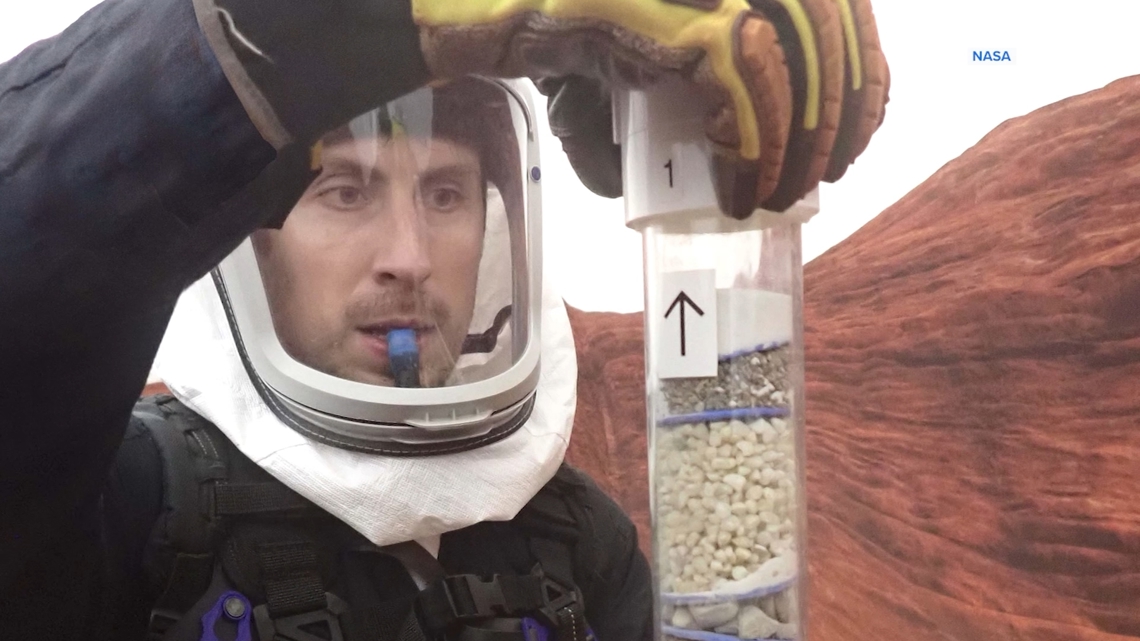
Inside NASA’s CHAPEA-2 Mars habitat, four volunteers are living like astronauts, with delayed communication and no way out until October 2026.
HOUSTON — What’s it really like to live on Mars?
Right now, four research volunteers are getting a taste of that reality without ever leaving Earth.
They’re part of NASA’s CHAPEA-2 mission, a yearlong simulation designed to mimic life on the red planet. Inside a 1,700-square-foot, 3D-printed habitat at Johnson Space Center, the crew is living in isolation cut off from the outside world since October 19, 2025. They won’t emerge until October 2026.
Why talking to them isn’t easy
Communicating with the crew comes with a major challenge: delay.
Messages can take up to 22 minutes to reach the habitat and another 22 minutes for a response.
That meant a traditional interview wasn’t possible. Instead, the crew recorded answers to questions and sent them back just like astronauts would on Mars.
Inside the Mars simulation
Life inside the habitat is designed to mirror a real mission to Mars.
Crew members run experiments, grow crops and solve problems as they arise all while navigating the physical and psychological challenges of isolation.
“Preparation for this mission is very similar to a long-duration military deployment,” said Commander Ross Elder.
The simulation even includes “spacewalks,” performed either in virtual reality or in a large sandbox outside the habitat.
Living with isolation and delay
One of the most critical elements of the mission is the communication lag, typically 15 to 22 minutes one way.
That delay forces the crew to operate independently, making decisions without immediate guidance from mission control.
“Ultimately this drives the crew to be a very isolated team,” Elder said.
Researchers are closely studying how that isolation combined with delayed communication affects performance, mood and mental health.
The hardest part: life back home
For many crew members, the toughest challenge isn’t the science, it’s the separation from loved ones.
“We’re here for an entire year… we’re going to miss a lot of family birthdays, anniversaries, weddings,” one Flight Engineer James Spicer.
“You can go without most things, but leaving those relationships has definitely been the most challenging,” said Science Lead Matthew Montgomery.
Why they signed up
Despite the sacrifices, the crew says the mission has a larger purpose: helping pave the way for future human exploration of Mars.
“I want our country to get there,” said Medical Officer Ellen Ellis.
The team also shared a message for future astronauts who may one day make the journey:
“Good luck, enjoy the journey and Godspeed,” said Spicer.
What they’re missing most
The crew is expected to return to the real world on October 31, 2026.
When they do, some of the first things on their list are simple but meaningful.
Spicer says he’s looking forward to eating real food again, after months of mostly freeze-dried meals.
And Commander Elder? He’s ready for something many people take for granted: Being around other people and all the noise that comes with it.