
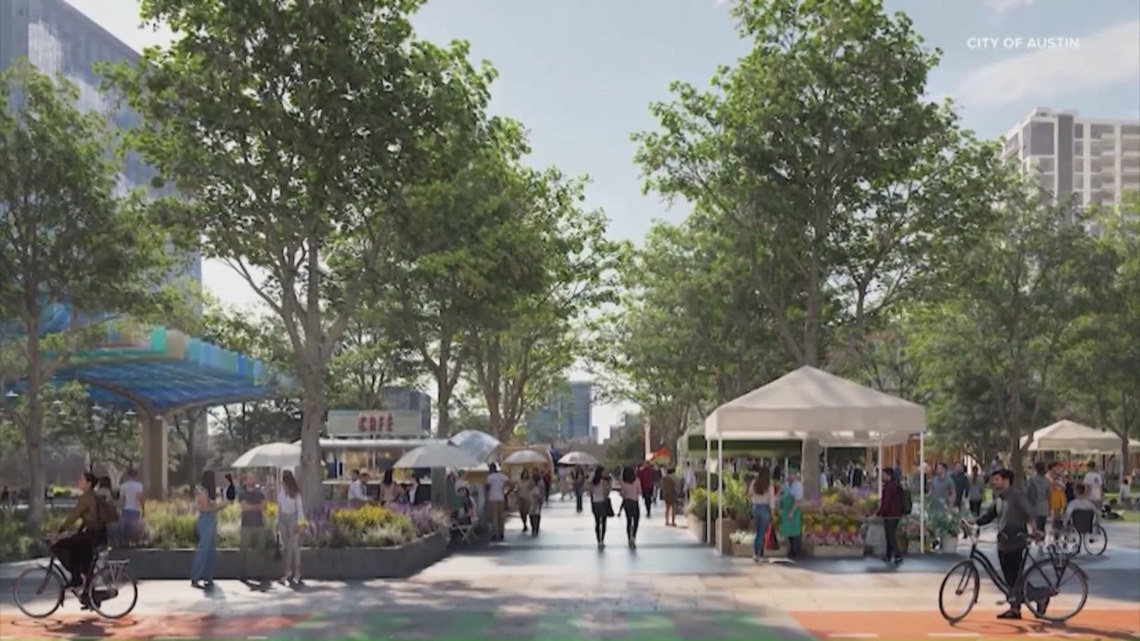
On Tuesday, Austin City Council was updated on the project, which calls for building cap decks and new connections over a wider, sunken highway in Central Austin.
AUSTIN, Texas — Some Austin city leaders are raising concerns about how to pay for the next phase of the proposed I-35 “cap-and-stitch” project, as key funding sources remain uncertain.
During Tuesday’s Austin City Council work session, city staff recommended not spending any additional city money beyond what has already been approved toward Phase 2 of the project: designing and building decks and tunnel elements.
The project is tied to TxDOT’s plan to widen and lower I-35 through Central Austin. City leaders hope to build three deck plazas downtown and two pedestrian and bicycle crossings near 41st Street over the reconstructed highway, reconnecting communities divided decades ago.
City council has already committed $104 million toward supporting infrastructure. However, the cost to build the decks and crossings remains unfunded.
Estimates presented to council show:
- The full buildout could cost $604 million
- The next phase alone — including decks and tunnels — is estimated at about $366 million
Funding challenges
Two major funding sources remain uncertain:
- Federal funding: A previously awarded $105 million grant was eliminated under the One Big Beautiful Bill Act signed by former President Donald Trump.
- Private investment: City officials say no philanthropic or private partners have committed funding so far.
Kim Olivares, Austin’s Director of Financial Services, told City Council the city is beginning outreach efforts.
“We’ve already arranged for continuing conversations… so we can take those next steps. But… if there are folks that are ready, will you please contact us?”
When asked by Council Member Mike Siegel if there are any offers currently, Olivares replied, “No.”
Council debate: scale back or think long-term?
The uncertainty is prompting debate among council members about whether to scale back the project or stay focused on its long-term vision.
Council Member Marc Duchen expressed concern about investing in early phases without a clear path forward.
“There is a sort of worst outcome here where we invest $104 million… and then… struggle to adequately fund the additional phases of this project.”
Duchen also questioned how realistic it will be to secure the remaining hundreds of millions of dollars needed.
Meanwhile, others emphasized the generational impact of the project.
Council member Ryan Alter urged patience, framing the effort as a long-term investment.
“It’s not about what happens in the next four years or ten years… this is about what happens in the next 100 years… communities that should have been connected 100 years ago.”
Alter and Mayor Pro Tem Chito Vela also pointed out that future federal funding opportunities could emerge under different administrations.
What’s next
Despite financial uncertainty, the City of Austin must decide by May which cap deck locations it will commit to in coordination with TxDOT.
That decision could shape whether the project moves forward as envisioned — or in a scaled-back form.