
The admission came during testimony at a hearing as part of a lawsuit filed by the family of Cile Steward, an 8-year-old from Austin whose body has not been found.
AUSTIN, Texas — Testimony continued on Tuesday in a Travis County courtroom as the legal battle between Camp Mystic and families who lost their children in the deadly Hill Country flooding last summer drags on.
A district judge is hearing evidence and testimony about what happened in the early morning hours of July 4, 2025.
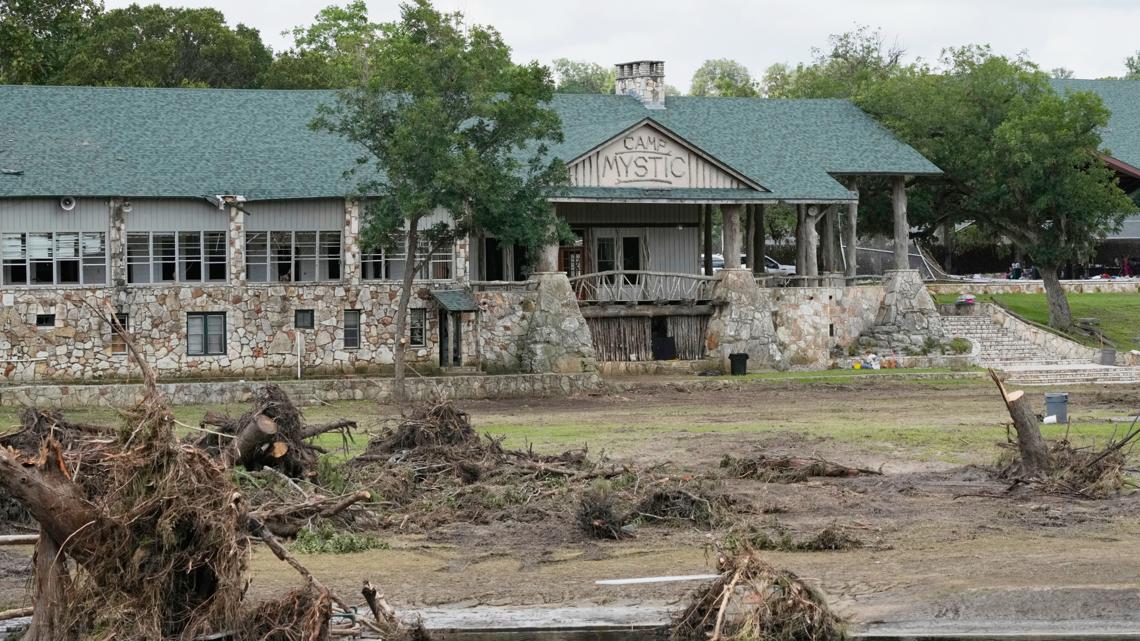
Twenty-seven campers and counselors lost their lives when catastrophic flash floods swept through the Kerr County summer camp. The devastating July Fourth weekend flooding killed at least 135 people, the majority of them in Kerr County, along the Guadalupe River.
The hearing comes after Camp Mystic appealed a judge’s order mandating the camp preserve damaged cabins and other parts of the campus. It was part of a lawsuit filed by the family of Cile Steward, the final missing camper from Camp Mystic, against the camp. Her body has never been recovered, and recovery efforts are ongoing. The family is suing the camp and several members of the Eastland family, whose “conduct, inaction and decisions,” the lawsuit argues, led to 27 campers and counselors being “needlessly killed.”
The courtroom was packed with those who lost family members during the flooding at Camp Mystic.
During a hearing last month, Judge Maya Guerra Gamble granted a temporary injunction. She ordered Camp Mystic to halt any construction at the Guadalupe River campus, because lawyers for the Steward family said the camp could destroy evidence they need for their lawsuit.
The temporary injunction restricts Camp Mystic from altering, demolishing, repairing, remodeling, reconstructing or removing any structures or features where campers were housed during the floods. It includes the Main Office, Rec Hall, Harrison Hall and Commissary building. Gamble also ruled Camp Mystic can’t use the part of the camp that is closer to the Guadalupe River, where those cabins were located, for camp operations. The family that owns the camp, the Eastlands, can’t live on the property.
The court’s order allows the Eastland family to reopen Camp Mystic Cypress Lake, which is a neighboring property.
“There was nothing unfair about us asking for an order to stop the destruction of evidence in the evidence field until we get the information we need to pursue our case,” Brad Beckworth, an attorney for the Steward family, said.
Lawyers for the camp have argued the ruling was “deeply flawed” and said the camp will suffer harm if it is allowed to remain in place.
Beckworth and other attorneys for the Stewards questioned why, after the two sides reached an agreement at the end of the March 4 hearing that neither would present additional evidence, lawyers for Camp Mystic walked back from that agreement and appealed to the Court of Appeals.
Britt Eastland, who runs Camp Mystic Cypress Lake, said he did not feel like he had gotten due process at any point.
Tuesday’s testimony
The day began at the spot where the previous day left off, with Edward Eastland, the camp’s director and the son of owner Richard Eastland, back on the stand. Richard Eastland died in the floodwaters while trying to rescue campers.
Edward Eastland said that Camp Mystic did not receive a warning about the floods; however, Beckworth noted that there were several flood alerts for the Camp Mystic area. Beckworth has pinpointed various warnings issued by the National Weather Service and the Texas Division of Emergency Management leading up to the deadly July 4 flood, and questioned Eastland about why camp leaders were not more prepared.
Eastland said he was signed up for an emergency warning system on his phone and believed the local “CodeRED” mobile phone alert system and other weather apps on his phone were enough. Eastland said he believed the warnings from TDEM and NWS in the lead-up to the overnight hours of July 3 into July 4 “should have made it more of an alert” that “would go off on your phone,” like the urgent alert from the NWS that came through at 1:14 a.m.
“Did you want a trooper to come knock on your door and tell you to do your job?” Beckworth asked.
“No, sir,” Eastland responded.
“What should the state have done?” Beckworth asked. “Should they have shown up and said, ‘Wake up, go save these kids?’”
“I think it should have been a more urgent alert,” Edward said. “I think it should have been one of those government alerts that sounds like an AMBER Alert. I think it should have said more in that initial text.”
While Eastland said he received a series of alerts during the flooding, his wife, fellow camp director and the camp’s chief health officer, Mary Liz Eastland, said she was not signed up to receive the alerts and did not know about the Flash Flood Warning in advance.
“I didn’t know the magnitude of what happened,” Mary Liz Eastland said.
Mary Liz Eastland said he did not receive a Flash Flood Warning from the National Weather Service at 1:14 a.m., or a CodeRED alert text message around the same time.
Camp leaders said they chose not to use the loudspeaker system, which was working, to inform campers and counselors of the flood risk ahead of time or instruct them to evacuate their cabins and get to higher ground during the flooding.
Mary Liz Eastland said during the flooding, she was concerned about 150 campers and counselors staying at Senior Hill, a place on higher ground at Camp Mystic. That part of the camp was effectively cut off from the rest of the camp because a bridge was overtaken by water. All the campers and counselors who were there during the flood survived and were unharmed, though it took several hours before they could be rescued.
Mary Liz Eastland said she had no way to reach them because there were no cellphones or walkie-talkies in the cabins. Lawyers for the Steward family played a 911 call made by a counselor who secretly kept their cellphone around 4 a.m., as cabins began to take on water.
Mary Liz Eastland said she was asleep when her husband, Edward Eastland, was woken by a call from his father, Dick Eastland, to move canoes and kayaks to higher ground.
A few hours later, Mary Liz Eastland said Edward Eastland told her the woman in the guard shack at the front gate called for help after being washed away by the water. Shortly after, Mary Liz Eastland said she looked out her door and saw how high the water had gotten.
“When there were lightning strikes, I could see how vast the river had gotten,” Mary Liz Eastland said.
Mary Liz Eastland described how she, her children and her mother-in-law broke a window to escape their house and fled to higher ground as water rushed in. She grew emotional while talking about the process of determining who was accounted for and who was missing after the flood waters tore through the camp.
“I had to figure out who we had and didn’t have at that point,” she said.
In the first few hours, she did not try to enter low-lying areas to help campers and counselors escape from their cabins because she said she could not get past the floodwaters.
Christina Yarnell, an attorney for the Steward family, slammed Mary Liz Eastland for not doing more to help the campers and counselors.
“It is difficult for me to hear that it’s been 34 years since you’ve been there and you did this little to help save these children that were under your care,” Yarnell said. “You knew the property. You knew the flood lines. You knew you knew access points. Your children knew them. These were first-year campers. You had 34 more years of experience than Cile. She needed your help, and you abandoned her, didn’t you?”
“Yes,” Mary Liz Eastland replied.
Deaths not reported
Mary Liz Eastland said she has not officially reported the deaths to the Texas Department of State Health Services, which regulates summer camps. Texas administrative code requires camps to report deaths to state health regulators within 24 hours.
“I did not think of this requirement in the moments happening after the flood,” Mary Liz Eastland said.
She also could not recall exactly when she found out that campers had died, only saying that it could have been a day or several days later.
Asked if the camp should formally report the deaths now that it has applied for a license for this summer, Mary Liz Eastland said, “I guess so.”
Camp Mystic leaders have testified that the camp lacked a detailed written flood-evacuation plan. Mary Liz Eastland said the evacuation portion of the camp’s emergency plan was to “wait for instruction” from “someone else in their office.”
Lawyers for Camp Mystic argued that the warnings in the days leading up were for a vast eight-county area that included Camp Mystic.
Beckworth questioned the Eastlands about why more family members did not act to help the campers during the flooding.
“All of this information was there and available for you and your entire family to utilize. All of the information was there,” Beckworth said, “if you had just looked.”
“We were looking that night,” Edward Eastland said.
“You didn’t look at the right things, did you?” Beckworth said.
“We didn’t look at the things that you have put up,” Edward Eastland said. “But we were looking at other weather alerts.”
While lawyers for Camp Mystic have expressed sympathy for the girls’ families, they have maintained that there was little they could have done because the flooding occurred so quickly as the Guadalupe River rose. The surging waters raised the river from 14 feet to 29.5 feet in an hour.
Edward Eastland said they could not have anticipated the storm’s severity, and by the time they decided to evacuate the cabins around 3 a.m., the water was so high and so fast that rapids were swirling around some cabins.
Edward Eastland was emotional at times in his testimony as he recounted grabbing two girls as a third jumped on his back before the floodwaters swept them away, and he ended up in a tree.
Last month, the camp submitted an application to renew its state license. If state officials approve their license renewal, Camp Mystic wants to reopen partly. The application is for their Cypress Lake campus, which is separate from the Guadalupe River campus where the campers and counselors died, and was not affected by the flood.
When they filed their license with the state of Texas, Beckworth said Camp Mystic said they would use all of the camp and plan to do activities that are only on the Guadalupe side of the camp, like have kids snorkeling in the Guadalupe River, which they argued was a “complete disregard” of the judge’s injunction order. Edward Eastland said that was a mistake and the camp submitted outdated material with an inaccurate list of activities they plan to do this summer.
“It’s not been an easy decision for our family at all, but we’ve been praying about it, and we’ve heard from hundreds of Mystic families and Mystic alumni that it would be healing,” Britt Eastland, who runs Camp Mystic Cypress Lake, said. “We’ve decided that this was a campus that did not have any flood damage, so we would try to make a very positive and healthy experience and safe experience for what looks to be as many as 825 enrolled families.”
Safety changes
After the tragedy at Camp Mystic, Texas state lawmakers passed a bill requiring local governments to install outdoor sirens and warning systems in flash-flood-prone areas. That legislation also included a grant program to help pay for those sirens.
Camp Mystic leaders said they’ve added a new flood warning system in recent months, installing sensors and sirens near campgrounds that will communicate with other sirens along the Guadalupe River.
“We’ve not only tried to comply with the new legislation but also tried to go above and beyond, to give confidence to our parents who are entrusting their daughters to us. Now that we know what a flood of this magnitude can do, everyone in this area has come together, and the whole country, community, and we have almost installed as many as 100 River Sentry Company flood alarm systems,” Britt Eastland said. “They are reactive flood alarm systems that take the human element out of it. They work in real time, so a person doesn’t have to be awake for them to go off. They are placed in locations on people’s property to give them a very reasonable amount of time to evacuate their family safely if they’re homeowners, and also, the camps in the area to evacuate campers and counselors to mustard stations, and they will soon alert directors that have these cubes under their beds that will sound an alarm to wake up.”
A spokesperson for the Texas Department of State Health Services (DSHS) said the state agency has received numerous complaints about the camp and is currently investigating them. The Texas Rangers are assisting the Texas Department of State Health Services in investigating complaints of neglect at Camp Mystic. The Texas Rangers typically investigate criminal allegations, but they can and have worked on administrative investigations.
DPS said separately that the Rangers’ search-and-recovery mission for the remaining flood victims, including Cile in Kerr County, remains ongoing.
Camp Mystic said it has cooperated with “every investigative request we have received,” worked closely with the Texas Rangers since the floods, and would continue to do so.
Lt. Gov. Dan Patrick has publicly urged the DSHS to deny the license. State lawmakers are expected to convene investigative hearings to investigate what happened at Camp Mystic.
The Steward family has made clear they believe the state should deny Camp Mystic a license for last summer.
“It is so clear that they are incapable of keeping children safe and don’t even want to be there,” Cile’s mom, CiCi, said. “The camp should not continue under the same reckless leadership of the Eastland family.”
Lawyers for the Steward family want the judge to continue preventing the camp from making renovations or modifying its Guadalupe River site while their lawsuit and the search for Cile continue.
Lawyers for Camp Mystic argued that the Stewards’ legal team has made multiple visits to Camp Mystic and has had ample time and opportunity to bring in experts and do whatever they need to do with the evidence field.
Camp Mystic leaders said any changes they made to buildings were for safety reasons, to address structural issues or remediate problems like mold, but lawyers for the Steward family argued they were much more than cosmetic and substantive.
The Stewards’ lawsuit is one of five filed against the camp by families of several of the girls who died, arguing that camp leaders did not do enough to protect the campers as life-threatening floodwaters approached.
The hearing in Travis County is expected to last through Wednesday.
The process to review the license renewal application will take several weeks. As part of that process, officials will review the application materials and emergency plan and conduct a pre-licensure inspection.