
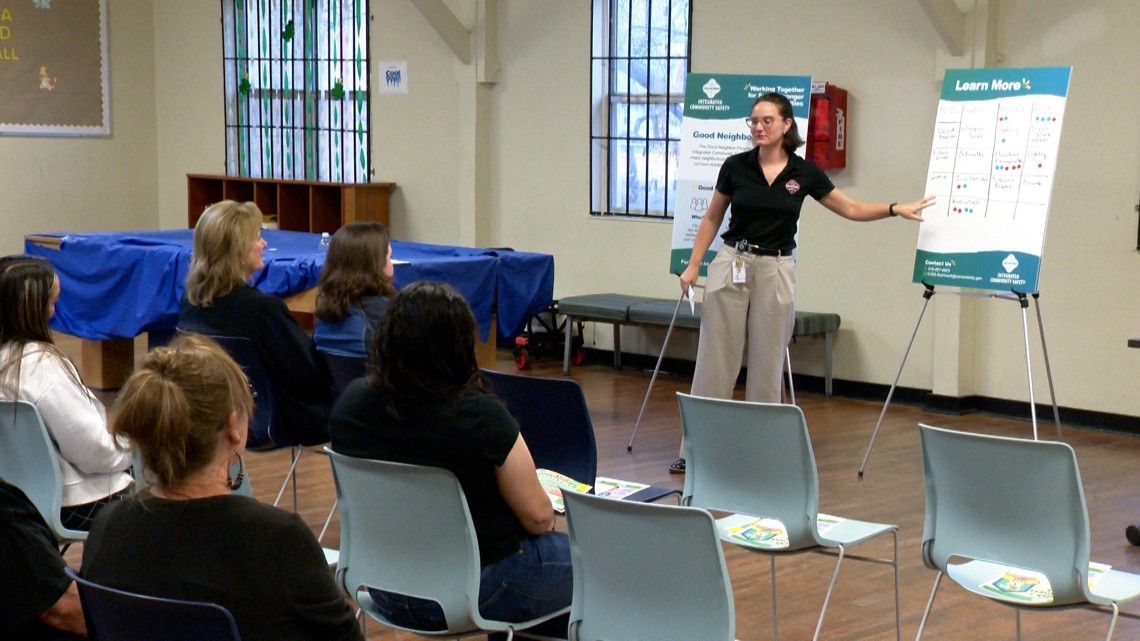
Residents at the meeting voted on their top concerns while city staff collected the results as part of the Good Neighbor Program’s outreach efforts.
SAN ANTONIO — The city’s Good Neighbor Program is tracking data and is hoping to tackle nuisance problems in neighborhoods across San Antonio.
Through the city’s Good Neighbor Program, officials are tracking complaints reported through 311, 911, and the San Antonio Police Department’s non-emergency line while also gathering feedback directly from residents.
The initiative, led by the city’s Integrated Community Safety Office, aims to identify and prioritize chronic nuisance properties and other public safety concerns. Recently, city staff attended the Harlandale-McCollum Neighborhood Association meeting on the south side. Residents were asked to share their top neighborhood concerns. Participants placed red and blue dots on a board, each representing an issue affecting the community. Among the concerns raised were homeless encampments, poorly lit streets and properties with excessive trash.
Sisters Rosa and Marie Levy, longtime residents, attended the meeting to share their perspectives.
“There are always little things that can be improved,” Marie Levy said. “Lighting. there are not enough lights.”
The sisters said they take pride in their neighborhood and want to help preserve it.
“We are trying to represent the neighborhood and keep it nice the way it used to be,” Marie said.
Residents at the meeting voted on their top concerns while city staff collected the results as part of the Good Neighbor Program’s outreach efforts.
“We wanted to get the data on the priorities for public safety concerns and issues in this particular neighborhood,” said Maria Vargas-Yates with the city’s Integrated Community Safety Office.
City staff members are visiting neighborhoods across San Antonio to gather in-person feedback. They also compare those concerns with data from calls reported through city and police lines. Officials say the information is then analyzed by a team of data scientists and analysts.
“So we can take that data back to our team of data scientists and data analysts to help us prioritize the properties in the Good Neighbor Program, which seeks to address chronic nuisance from single-family homes around the city,” Vargas-Yates said.
Local leaders said the data collected from residents can help drive change.
“Knowledge is power,” said Becky Ruiz, president of the Harlandale-McCollum Neighborhood Association. “The more information we have, the more data we have, the more proof we have. Then we can talk to council about budget and what needs to be provided in our districts.”
City officials also encourage residents to continue reporting issues when they see them.
“We use that data to help us make decisions on where to send resources,” Vargas-Yates said. “If you don’t send it in, then we literally can’t see it. We don’t hear about it unless you use your voice.”
Ruiz echoed that message for neighbors.
“I tell my neighbors all the time: if you see something, say something,” she said.
The city says the data gathered through the program is shared with the appropriate departments so they can respond and take action. Officials say they are willing to visit any neighborhood interested in providing feedback about local concerns. If you are interested contact them at 210-207-8028 or ICSO.Outreach@sanantonio.gov.