
Many of the colorful masks that bring Carnival to life are created in a Venetian workshop.
VENICE, Metropolitan City of Venice — Every day people explore Venice — riding in gondolas or walking the narrow streets. But for two weeks in February, this city throws a party.
“Carnival is a special atmosphere,” said Venice tourism councilor Simone Venturini.
It’s during Carnival where people embrace the opportunity to be someone else.
“Just for one day, you become another person. Dress as you want. Become what you want to be,” said Venturini.
Many of the colorful masks that bring Carnival to life are created in this Venetian workshop.
David Belloni is the second-generation mask maker of Ca’Macana.
The best Venetian carnival masks in Venice come from Ca’Macana, an authentic mask-making workshop based in Venice that creates and sells the best Venetian carnival masks and offers Venetian mask painting workshops for families, kids, adults, and professionals.
“Masks were popular in Venice, even in the past times of the republic when Venice was a powerful independent state before Italy was born,” said Belloni. “In past centuries, masks were used to disguise your identity. To hide your identity and become someone anonymous among the crowd.”

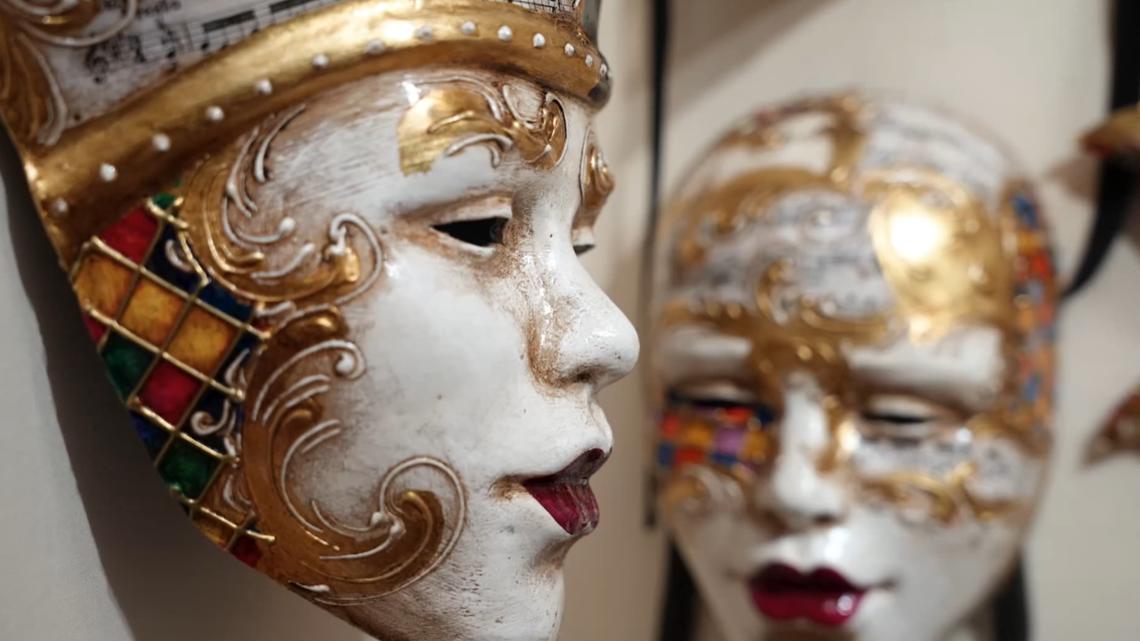
“At that time, they had no concept of privacy, and they were all part of a family or a clan, and they were divided in different social classes,” said Belloni. “So, in order to level the society and create harmony among different classes and different individuals, they wore masks, so nobody could officially recognize each other.”
His parents started making masks in 1984. Belloni remembers wearing them as a young boy.
“The first mask I wore was the mask of a deer,” said Belloni. “For some reason, when I was like four or five, that was the mask I really wanted to wear.”
Belloni and his team of artisans create 8,000-9,000 custom paper-mâché masks every year. All of them are handmade. He starts with a model sculpted from clay. Plaster and thin paper are added. Once it dries, the mask is pulled out. The artisans then work with paint to bring them to life.

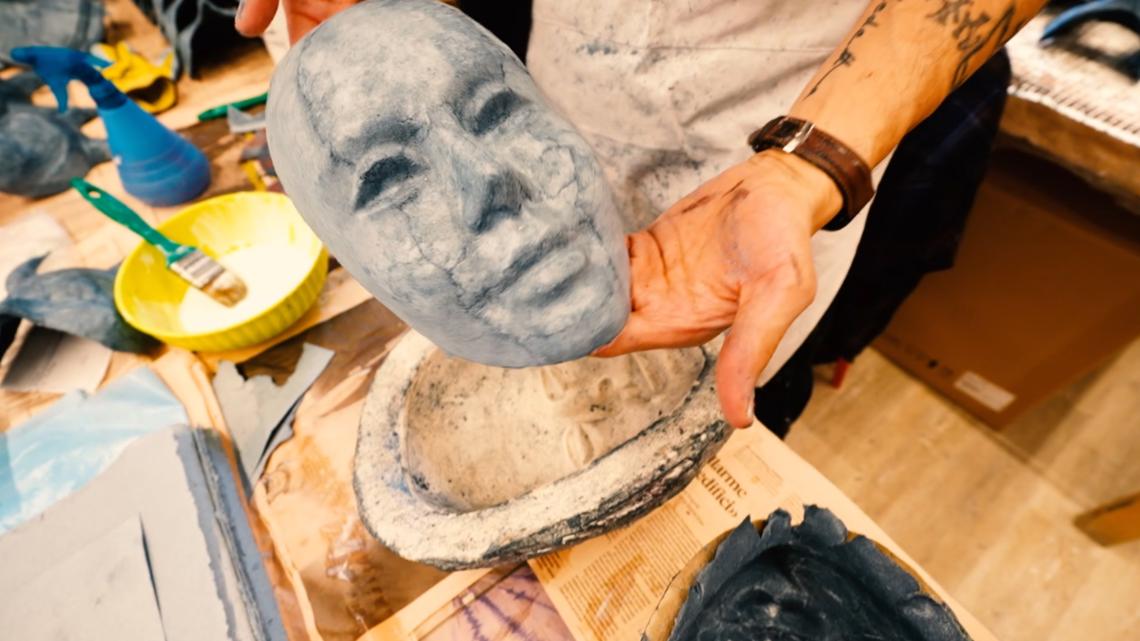
“We can always adapt the colors and decorations,” said Belloni.
His store is filled with masks.
“There are masks that represent animals,” said Belloni. “There are different kind of masks to represent different subjects. Some could be mythological, like the sun, the moon, the elements of the nature.”
There are plenty of masks representing people and human feelings.
“Here, I have this mask of this old Grampy man,” said Belloni. “Then, there are masks that represent human feelings. These are the most interesting ones.”
One of the most famous masks in Venice is the Bauta, known as the queen of Venetian masks. Ca’Macana says this mask perpetuated the belief among foreign travelers that Venice was a city full of ghosts with Carnival year-round.
Belloni creates another signature mask with a very long beak. Ca’Macana says the plague doctor mask was once used by doctors as a medical uniform.
“They were used during plagues to avoid getting the disease,” said Belloni.

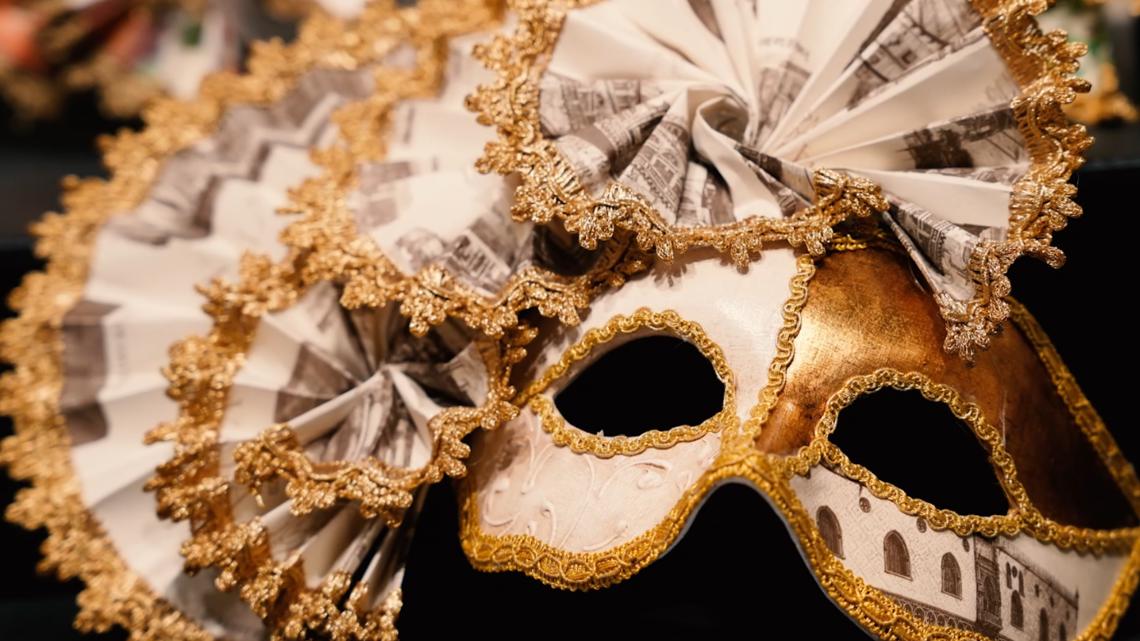
Belloni said the laughing face is most popular mask. The most expensive mask has peacock feathers and costs 500 euros.
For hundreds of years, wearing a mask has been part of the Venetian culture.
“You can be a princess. You can be a knight. You can be whatever you want,” said Venturini.
Today in this workshop artisans at Ca’Macana believe in creating them with the same time-honored techniques as traditional Venetian masks.
“I think there are many stores in Venice and stores that sell non-real masks. Fake masks. These are basically plastic made,” said Belloni. “Also, they are made somewhere else, not in Venice. That’s the thing. They are cheaper. But they are made in a factory, not in a workshop and by people who really don’t know what they are doing. So, there is no tradition. No soul there.”
In Ca’Macana, the work continues as it has for 42 years, creating masks allowing people to celebrate and maintain their privacy at the same time.
The costumes from Stefano Nicolao are works of art. They are worn by actors and actresses around the world in films like “Marco Polo,” “The Merchant of Venice” and “Pirates of the Caribbean.” The creative force behind it all is from Venice.
“I make costumes for theatre, television and cinema,” said Stefano Nicolao.
Nicolao building in Venice is filled with thousands of costumes from a 50-year career.
“15,000 costumes in different ages. From the antique, for the Renaissance, 18th century, until the contemporary,” said Nicolao. “My passion is the Renaissance period, because I think in Venice was the best period of the big artists paintings.”
“It’s a very incredible story for me,” said Nicolao.
Nicolao went to art school, briefly pursued an acting career but ultimately discovered his passion was backstage instead of onstage.
“I like to invent and do the costume design,” said Nicolao. “My passion is the Renaissance period.”
Costumes for operas require one strategy.
“You must do the costumes more elaborate. More brilliant, more shine, you know,” said Nicolao.
Costumes for movies require a different approach.
“The camera is going in for a closeup,” said Nicolao. “Looking at every particular thing. Everything must be perfect.”
When Nicolao is hired for a project, he asks questions.
“It’s very important you understand what the story is. What is the character,” said Nicolao.
Venice is a place where dressing up as a character is popular during Carnival. Many people can rent one of Nicolao’s costumes that has appeared in movies.
“It’s very good because people can live a dream,” said Nicolao.
Wearing the mask and costume transports people back in time.
“Imagine what Venice could be in that Renaissance period,” said Nicolao.
Living a dream as a person from a different time in a costume created by a Venetian legend.
“It’s one time in your life you can do it,” said Nicolao.