
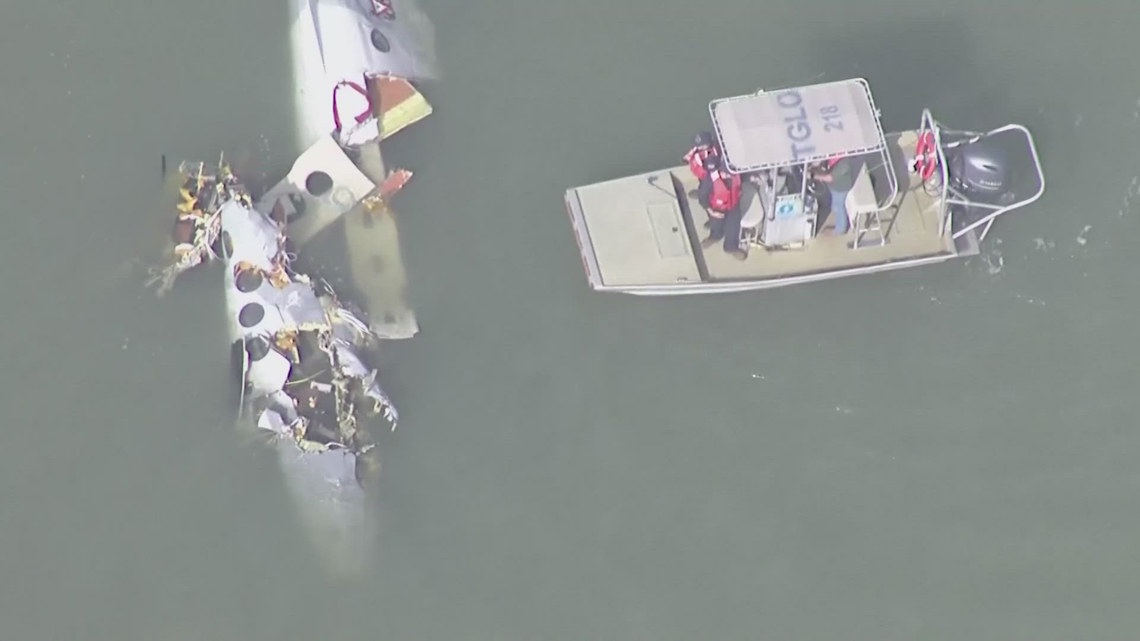
A commercial pilot and flight instructor reviewing public flight records says the aircraft was off its glide path as visibility dropped below legal minimums.
GALVESTON, Texas — As investigators with the National Transportation Safety Board work to determine what caused a deadly plane crash in Galveston Bay, a veteran commercial pilot and flight instructor says early evidence suggests the tragedy may have been preventable.
KHOU 11 spoke with Robert Katz, a pilot with more than 44 years of flying experience, who reviewed publicly available flight-tracking data and federal aviation records tied to the crash near Scholes International Airport.
Katz says the data shows the aircraft was well off its proper glide path as it approached the runway. According to flight information, the plane should have been flying at about 200 feet just before landing. Instead, it went down in the water roughly half a mile short of the runway.
“This was tragic, and this was entirely preventable,” Katz said.
Visibility below legal minimums
Federal Aviation Administration records show the minimum visibility required to land on Runway 14 at Scholes Airport is half a mile. Katz says a special weather bulletin was issued to pilots just minutes before the crash, warning that visibility had dropped to about a quarter mile due to dense fog.
“This pilot would have been aware of the weather conditions before he attempted the approach,” Katz said. “There was a special observation taken three minutes prior to the landing attempt.”
Under those conditions, Katz says the pilot should not have continued.
“It was not lawful at that point to continue the approach,” he explained. “They should have conducted a missed approach and diverted somewhere else.”
Flight data raises additional concerns
Katz says the aircraft’s flight logs also indicate the plane descended too low, too early, a move he believes may have been an attempt to spot visual landmarks through thick fog.
“That’s a very common mistake pilots make,” Katz said. “We want the confidence that comes from seeing something instead of flying blind.”
After what appeared to be an uneventful two-hour flight across the Gulf, Katz says the landing decision combined with the early descent likely proved fatal.
“It’s the pilot’s prerogative to attempt an approach,” Katz said. “But doing so when visibility is known to be below published minimums is foolish.”
No early signs of mechanical failure
Katz adds that based on the information available so far, there is no indication of a mechanical problem with the aircraft. He describes the plane’s model as reliable when properly maintained and flown by pilots familiar with its systems.
The NTSB investigation is ongoing, and officials caution that final conclusions will be based on a full review of evidence, including weather data, flight records, and aircraft wreckage.
More updates are expected as investigators continue their work.
Got a news tip or story idea? Email us at newstips@khou.com or call 713-521-4310 and include your name and the best way to reach you.