
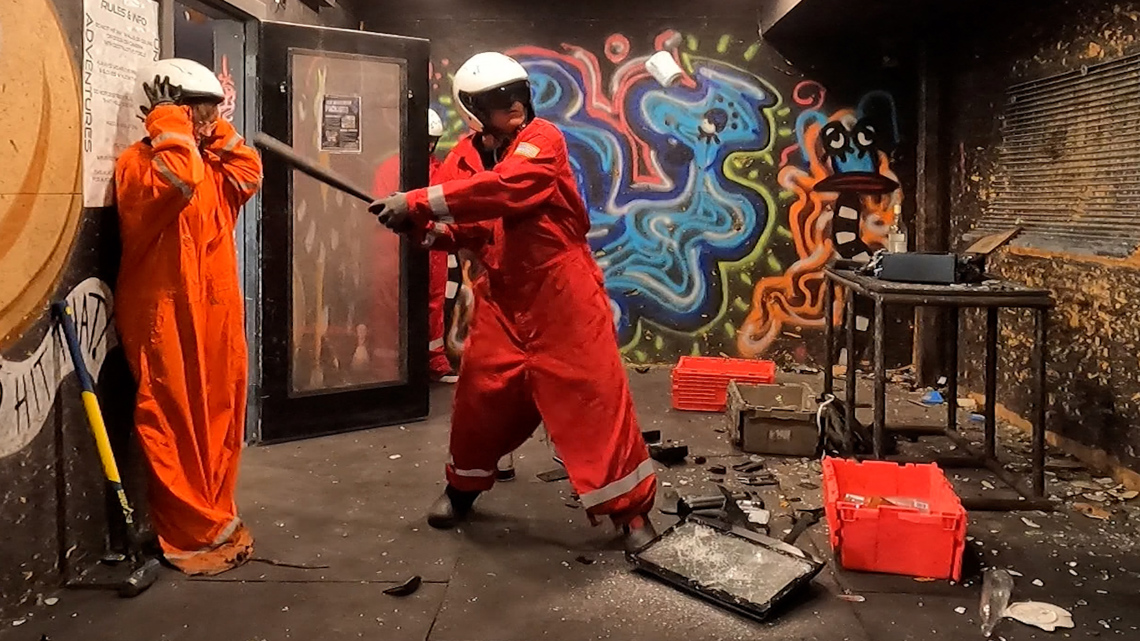
A Live Oak rage room launches a $5 scream line after a woman called just to yell, as research shows anger-release services are growing — especially among women.
LIVE OAK, Texas — The call wasn’t a prank.
Last month, a woman phoned Unchartered Adventures, a rage room in Live Oak, and asked for one thing.
“She told me that she just wanted to scream,” said owner Damon Fogley.
The moment stuck with him.
“We have a rage room — why not have a scream line?” Fogley said.
Last week, he launched one.
For $5, callers can reserve a five-minute time slot online and vent anonymously over the phone.
“They can say whatever they want. No judgment zone. They can use as much profanity as they want,” Fogley said. “That’s how I came up with the Scream Line.”
From junk removal to rage rooms
Fogley opened his first rage room location in Kyle in 2019 before expanding to Live Oak in 2023. Before that, he ran a junk removal business focused on keeping usable items out of landfills.
“We popped up a little room in the middle of our sorting warehouse and before I knew it, it blew up,” he said.
Rage rooms — which began gaining traction in Japan before expanding to the United States around 2018 — allow customers to pay to smash items in a controlled setting.
At Unchartered Adventures, customers can break glassware, electronics and even toilets.
“We have big sledgehammers, small sledgehammers, bats, bowling pins,” Fogley said.
Some customers request specific items tied to their stress.
“We get people that work in the tech industry and they’ll ask for certain items. They’re like, ‘I want a keyboard, I want a printer, I want a monitor,’” he said. “Say you work in the restaurant industry, you may want a dish to go smash.”
Keyboards are especially popular.
“You see little keys flying everywhere,” he said.
Toilets often sell out.
“I don’t know what it is, but toilets always sell out,” Fogley added.
Customers can also write what angers them directly onto plates before smashing them, or project images onto a wall to throw objects at.
Afterward, all broken materials are recycled. Fogley sources items from thrift stores that can’t sell certain goods, as well as empty bottles from bars.
He describes the experience as symbolic.
“You are breaking items into little pieces, then you’re closing that door,” Fogley said. “It’s almost like closure when you close the door and all the problems are still left in the room.”
“It’s cathartic. They feel so much better after they’re done.”
A growing trend — especially among women
Industry reports tracking rage rooms show the concept expanding nationwide, with more locations opening and increased customer bookings.
At Unchartered Adventures, Fogley said roughly two-thirds of his clientele are women — about a 2-to-1 ratio compared to men.
Dr. Erin Sumner, a professor of human communication at Trinity University, said that trend aligns with research on emotional socialization.
“Women are generally socialized to not act angry,” Sumner said. “Or if they’re acting angry, to do so in a more feminine way. And yet they’re still angry.”
She said anger is a biologically activating emotion.
“When we’re angry, we’re in this really elevated state where we’re ready to fight,” she said.
Unlike sadness — which may lead someone to withdraw — anger increases heart rate and prepares the body for action.
“It’s an emotion that a lot of people are afraid of and almost feel guilty,” Sumner said.
That can make structured outlets appealing.
“We have this feeling we need to get out,” she said. “We need to do something with our anger and we don’t want to do something we’ll regret later.”
Sumner said safe, controlled environments can provide space to process emotions.
“I think a lot of people might find rage rooms places that they can process how they’re feeling,” she said.
But she cautioned that release is not the same as resolution.
“If they start to use the rage room as an alternative to actually handling the source of their anger, then the source of anger is going to stay,” she said.
The key, she said, is regulation — using tools that help someone regain control.
“Anything that kind of helps you process how you’re feeling and regulate to a calm space where you don’t feel like your anger is running you like a puppet, but rather you’re in control and being thoughtful — those are healthy outlets,” Sumner said.
She added that movement can also help.
“Going for a walk is a great thing. Exercising is a great thing,” she said. “They talk about blowing off steam for a reason. We need to almost let our body calm down.”
Ultimately, she said anger itself is normal.
“Most of us feel angry on a pretty regular basis for both big things and small things,” Sumner said. “Feelings are facts. We can’t outrun them.”
A place to start
Fogley, a combat veteran who said he has been diagnosed with PTSD, said he relates to customers looking for an outlet.
“If a veteran comes in, I’m more than happy to talk to them about challenges,” he said.
He said some customers come in alone during the week, close the door and simply scream.
“They don’t say anything. They just want to go in,” he said. “You can hear them from the other side of the building.”
The Scream Line, he said, is simply an extension of that idea.
Not a cure. But a starting point.
“It’s cathartic,” Fogley said. “They feel so much better after they’re done.”
The Scream Line at Unchartered Adventures launched last week. Click here to learn more or to book a time slot.