
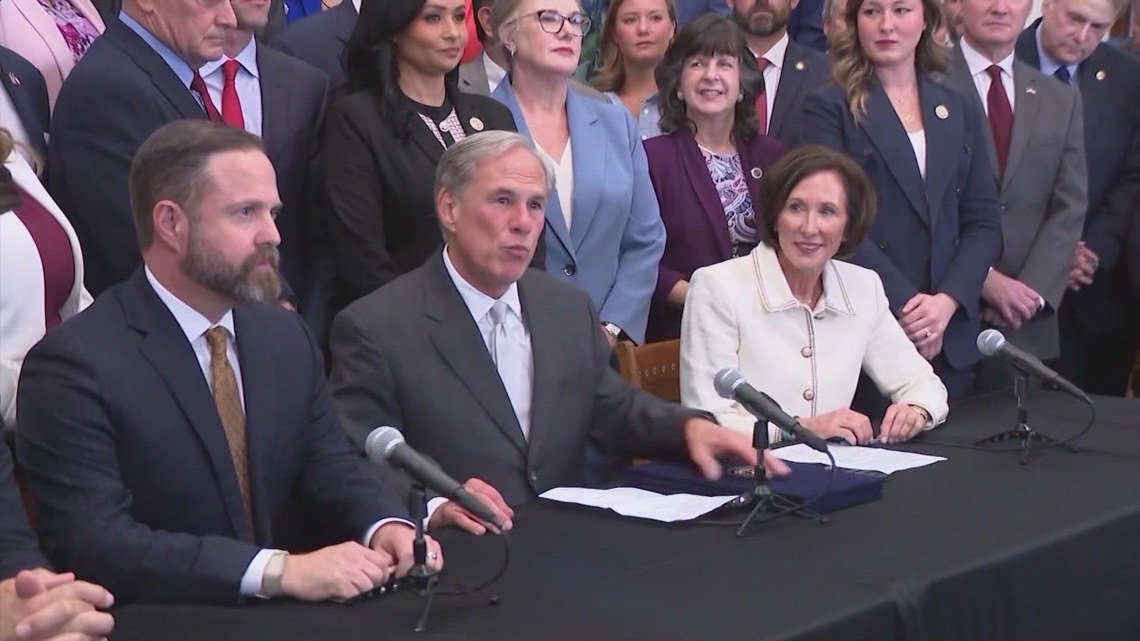
Abbott said he believes the new statewide prosecutor is needed because some Texas District Attorneys are not prosecuting criminals.
AUSTIN, Texas — Governor Greg Abbott is calling for a new top prosecutor position in Texas. The new prosecutorial office would have statewide jurisdiction and would be focused, he said, on taking cases that local district attorneys either do not or will not prosecute.
In a social media post on X on Monday evening, Abbott said he plans to ask state lawmakers to create a “Chief State Prosecutor” position.
“I am calling for legislation that creates a Chief State Prosecutor to actually prosecute criminals like this that DAs in places like Austin refuse to prosecute,” Abbott wrote.
It is something that retired Travis County district court judge and current Central Texas criminal defense lawyer Charlie Baird said has never happened before, because there are already provisions in place for that.
“The Texas attorney general has great prosecutorial authority throughout the state, and so it’s pretty much already a fait accompli that there is a statewide prosecutor,” Baird said.
Generally speaking, it is up to the district and county attorneys in those counties to prosecute crimes that occur within their counties.
“The framework for the criminal justice system within the state of Texas is that you want local authority and control over the crimes that occur within that county and you leave that primarily to the discretion of the local district or county attorney who the populace of that county has elected, so they have a direct input and how they want the individuals to be prosecuted and those cases handled,” Baird said. “Typically, the local prosecuting authorities have a much better sense of how the populace of that county wishes to have cases prosecuted.”
The Texas Attorney General’s Office has specified jurisdiction over some instances, for example, those involving voting rights. Baird said, in general, the Attorney General’s office has to be asked to get involved in a prosecution, though he noted they are often brought in on significant cases.
Abbott’s post on social media was in response to a post by the “@AustinJustice” account on X, highlighting Michael Nnaji, who court records show has faced more than 30 charges since 2019, ranging from misdemeanors for criminal trespass to felonies for things like aggravated assault and burglary. While court records show he was sentenced in several cases, the Governor’s office argues that the DA’s office hasn’t done enough to pursue cases against him in recent years, leading to charges in some cases being dismissed or reduced.
“Progressive DAs are literally leading to the murder of Texans,” Abbott wrote. “Those DAs must be held accountable and prosecutorial power must be shifted to actual prosecutors.”
KVUE reached out to Travis County DA José Garza’s office on Tuesday afternoon for comment on Governor Abbott’s post, but we have not heard back.
Baird said Abbott is taking a macro view of what is happening.
“He’s spotting very few cases that he feels like or not have been prosecuted aggressively as he would like to see,” Baird said. “But by the same token, he does not have the knowledge and the wherewithal and the information that the local prosecuting authority does to see why the case was resolved in a certain way.”
Baird said violent crimes like murder tend to have higher priority for prosecutors, while things like drug crimes that are lower in level tend to have less priority.
“Each case is different. Each defendant is different.” Baird said. “You need to take into account those differences and the idiosyncrasies of those particular cases and how they should be prosecuted.”
For prosecutors, resources are always a factor in deciding how to proceed with a case because some cases require substantial resources to prosecute, while others do not.
“You just really have limited resources, not just in prosecutor’s offices, but also in law enforcement agencies. Criminal defense lawyers are limited to public defender’s offices, and the courts are already stacked and have very busy dockets,” Baird said. “It’s not just a question of what the local prosecutor is handling the case. It’s just more of a question of the overall system and how it impacts everyone.”
Baird said there are other states with similar positions through their state attorney general offices. However, even in those states, local prosecutors still have significant discretion in how to handle cases. If the state does step in, Baird said it is done only after extensive interaction and consultation with the local prosecuting authority to figure out why the case is being prosecuted the way it is.
There is a state law that targets “rogue” prosecutors. Travis County District Attorney José Garza faced a failed removal from office attempt under that state law. It was among the first in the state to be filed under the bill that sought to remove prosecutors from office for policies of not pursuing certain kinds of cases.
House Bill 17 from 2017 allows courts to remove district attorneys for “official misconduct.”
A judge dismissed José Garza from office in December 2024, citing that Garza’s first term was about to end and that the suit was based on that term. Garza assumed office for a second term in January after winning in a landslide election in November 2024.
That lawsuit accused Garza of indiscriminately pressing charges against law enforcement officials and presenting those cases to grand juries. The lawsuit alleged he keeps a list of law enforcement officials he deems unfit to testify. It also argued that Garza has refused to prosecute certain crimes by not pursuing abortion-related cases.
“There’s already a mechanism in place that if individuals within the county feel like the individual prosecutor is not doing a good job in prosecuting the case, then they can seek to have him removed and a new prosecutor appointed,” Baird said.
In November, Texas voters approved a bail reform constitutional amendment that requires denying bail under certain circumstances to persons accused of certain offenses punishable as felonies. There are nine crimes in this statute that a judge could deny bail under, including murder, aggravated assault that either causes serious bodily injury or if a weapon is used, aggravated felonies, which generally means a weapon was used or trafficking of persons.
Texas judges could already deny bail for some of these crimes, or if someone is accused of committing a crime while out on bond, but it did not always happen.
While the proposition said it required denying bail, judges still have discretion, which makes it much easier to deny bail.
“It should be known that Texas has the highest per capita population of individuals in prison than any other state,” Baird said. “It’s very difficult to understand how Governor Abbott could figure out or say that individuals are not being prosecuted aggressively in Texas.”
Baird said adding more layers to an already complex criminal justice system might add more problems.
“I think if you add an extra layer across the state in the criminal justice system, it’s going to complicate things immeasurably and make it more time-consuming and difficult to prosecute these cases to some level of finality that everyone’s satisfied with,” Baird said.
State lawmakers are not scheduled to return to the state capitol until the 90th Regular Legislative Session in January 2027.