
“Twenty to thirty percent of the world has a PFO. You’ll never know it,” said Dr. Khaled Khalaf.
HOUSTON — February is American Hearth Health Month and we’re putting the spotlight that impacts about one in four adults, even if they don’t know they have it.
“Twenty to thirty percent of the world has a PFO. You’ll never know it,” said Dr. Khaled Khalaf, an interventional cardiologist with Vital Heart and Vein. “They’re asymptomatic. The only reason we find them is because people give us a reason to look.”
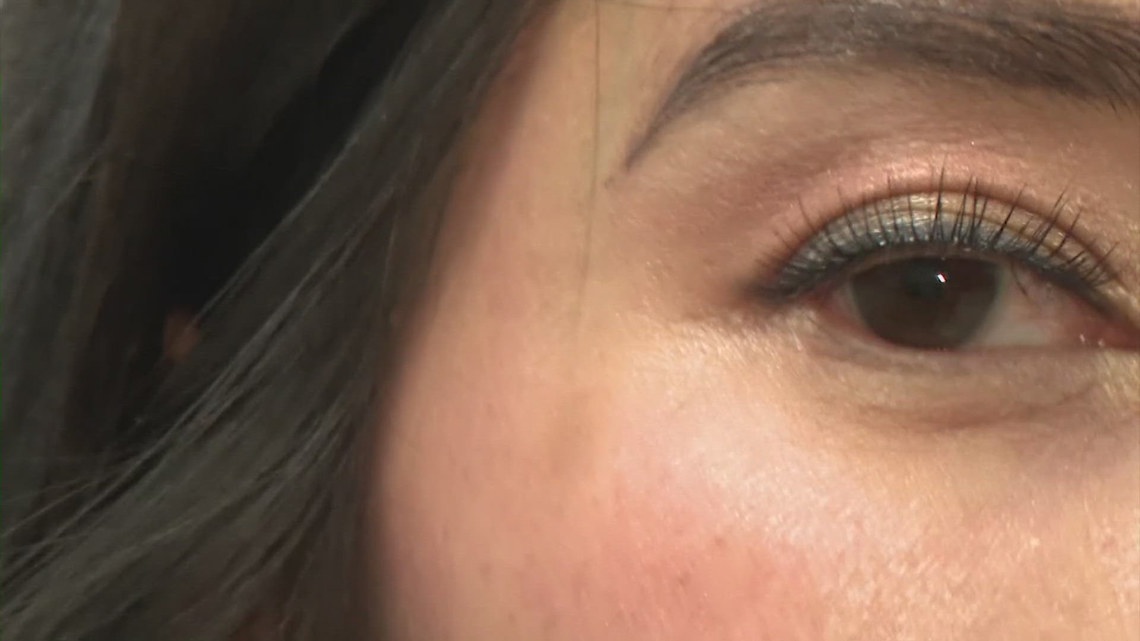
In one rare case, a Houston woman found out she had the condition, Patent Foramen Ovale (PFO), after going partially blind in one eye.
“I’m just glad I wasn’t crazy and seeing things,” said Tiffany Su. “It was pretty early in the morning, so at that time, you’re like half asleep, half awake, not sure what you’re seeing, and I had noticed that the upper hemisphere of my right eye, in terms of my vision, I couldn’t see through it.”
Su was unaware she had PFO, which was causing her temporary blindness.
“When you see a doctor and you go to the ophthalmologist, they test your vision by doing these motions, you know, if you could see. So, I basically did this test, and I could not see my fingers up here and I could see it down here, but I couldn’t see it up here,” Su said.
“I mean, going blind temporarily is it’s not like your mind’s playing tricks on you. Obviously, something happened to cause that,” Dr. Khalaf said.”
Khalaf said PFO is a condition that develops after birth.
“It’s a conduit, or a hole, in the heart by which tiny clots have the ability to pass through,” the doctor explained. “You end up with the stroke-like symptoms, mini stroke-like symptoms, you know, a drooping of the face, weakness or numbness on one side of the body, and that’s usually how these things present. Sometimes we do see it manifest itself as in-the-eye symptoms.”
Su ultimately regained vision in her right eye, but was determined to find out what was wrong.
“The body is miraculous,” Dr. Khalaf said. “Her body recognized that there was a clot from somewhere, and she essentially dissolved it on her own.
“It was gray, completely gray, like grayish black,” Su said, describing the blind spot. “I kept closing my eye, and checking back and forth to see if I was actually seeing something. I just didn’t want it to occur again.”
First, she saw an optometrist. The optometrist referred her to an opthalmologist, who pointed her to a cardiologist after numerous tests couldn’t pinpoint what caused the temporary blindness.
“We don’t have the technology to replace vision. If you lose your eyesight, unfortunately, it’s not like you can get an eye transplant, so it’s pretty permanent and life-altering,” Su said. “It’s not something to take lightly.”
“My radar for PFOs is very high, but unfortunately, that’s not the case with most other specialties, even within cardiology itself,” Dr. Khalaf said. “We can’t close them because of migraines, either. There has to be some kind of a neurological event to justify closing it.”
After seeing a post Su made on social media, Dr. Khalaf connected with her to surgically resolve her PFO.
Su considers herself lucky.
“Worst-case scenario is, I could throw another clot and completely lose my vision and become blind,” Su said. “Definitely seek out. Don’t just trust your results. If everything’s coming out negative, just do your due diligence and seek the specialists necessary to make sure you rule out every possible avenue.”
Su also said it took her months to get the procedure to shut her PFO due to insurance companies not typically covering the procedure. Her surgeon fought for her to get it paid through her healthcare plan.
Got a news tip or story idea? Email us at newstips@khou.com or call 713-521-4310 and include your name and the best way to reach you.