
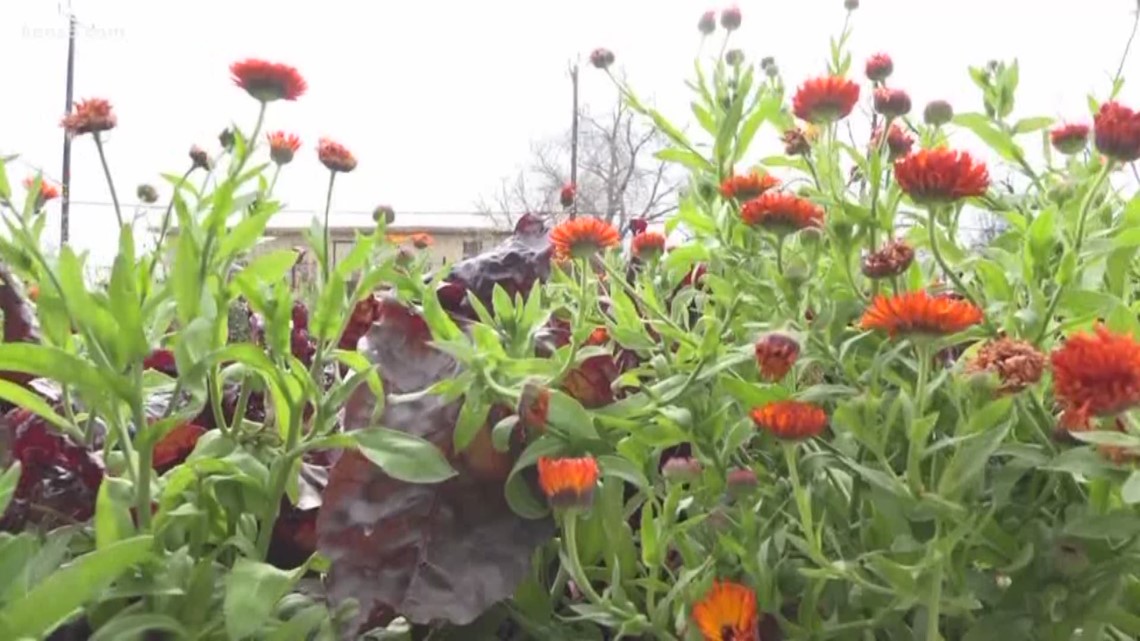
As a San Antonio cold snap looms, Fanick’s Garden Center is offering essential tips for plant protection and resilience through the freeze.
SAN ANTONIO — A weathered sign outside Fanick’s Garden Center on Holmgreen Road quietly proclaims their deep connection to green growth: “Established 1939.”
It’s an east-San Antonio oasis where the roots are now four generations deep.
With a cold blast getting ready to blow into town for a prolonged freeze, their green team on Thursday invested in battening down the hatches over the six-acre compound that is home to thousands of plants.
While scurrying around looking for misplaced heaters, Danielle Croft stopped just long enough to offer up time-honored tips for preserving landscaping features during the deep freeze.
“Right now, you want to make sure that you’re covering your plants,” she said. “Never put plastic directly on the plants. Put some kind of cloth first to insulate, like old sheets (or) blankets, all the way to the ground. The heat’s produced from the bottom up, so you want it to go all the way down.”
Croft said plastic covers or tarps can do more harm than good if they are directly on delicate foliage.
“Because it actually conducts the cold more and it does more damage than if you just left it out in the open,” Croft said.
She said watering is good, but balance is the key.
“You don’t want to water too much, but you want to water enough so that the plant can produce its heat,” Croft said.
Croft added that plants that go without any water can sustain root freeze.
Rather than covering everything in place, Croft said it might be smarter to just move smaller items to give them the advantage of better shelter, and then cover.
“When in doubt, bring in any small pots you can put on a porch,” she said. “Just cover them there and anything that’s too big, same thing: put it on the porch, cover it up.”
For landscaping features that are in the ground, Croft shared a rule for mulching.
“It’s two, two, two,” she said, by which she means: Two inches away, two feet around and two inches thick.
“That’s the rule,” Croft said.
Finally, Croft said, if plants take a hit and look bad when the weather starts to thaw, take heart. She said the warmer weather lately has confused many plants.
“If something dies back, don’t panic. Because we’ve had such warm weather, everything thinks that it’s spring, so everything’s going to die back. A lot of the perennials, things like that, they’re going to die back. That’s OK,” Croft said. “Give it until probably April to start coming back out. Don’t freak out and replace right away. Give it some time to come back out.”
Fanick’s has a long history of public education, offering frequent seminars. They are open every day from 8:30 a.m. to 5 p.m. at 1025 Holmgreen Road.
The next class is scheduled for Jan. 31 at 9 a.m. with Dr. Larry Stein from the Texas AgriLife Extension Service. The topic: Fruit Tree Basics.