
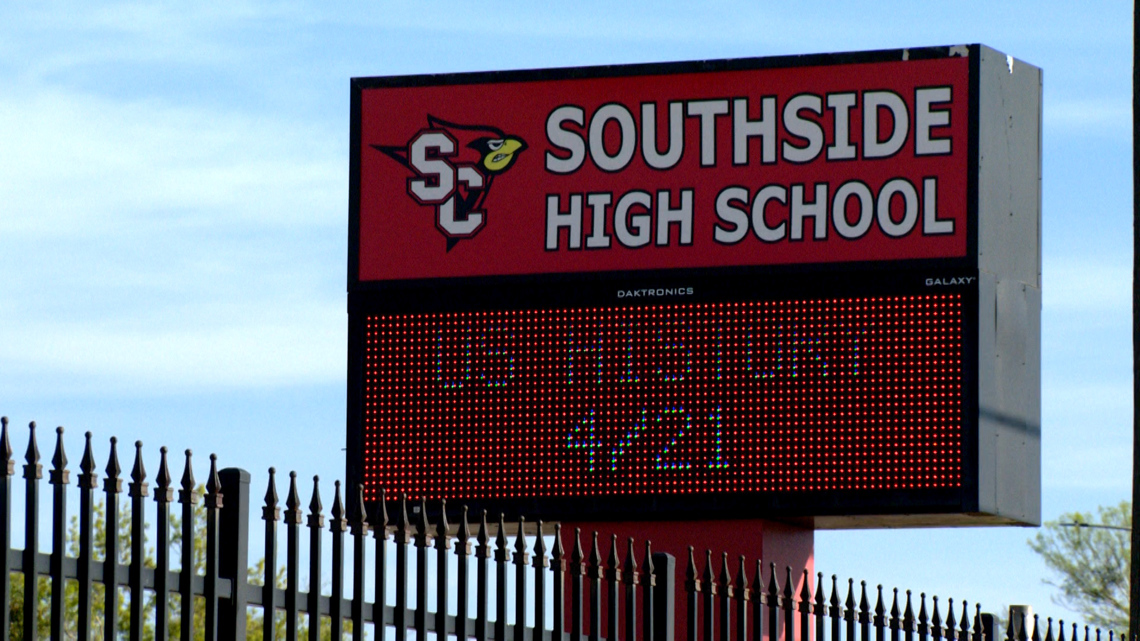
A Southside ISD student is being marked absent for a class she can’t physically reach due to a broken elevator. She says outages last weeks and date back two years.
SAN ANTONIO — A Southside ISD high school student who uses a wheelchair is struggling to access her classes due to a malfunctioning elevator, raising concerns about accessibility, safety and communication within the district.
Her grandfather, Jose Lopez, says the issue has persisted for years and is now affecting his granddaughter’s education — and potentially others who rely on the elevator.
“They think we’re gonna allow it to happen. I can’t. There’s just no way. That’s what I’m here for. I’m a granddad,” Lopez said.
Lopez has three granddaughters enrolled in Southside ISD. One of them, a junior at Southside High School who uses a wheelchair, depends on the elevator to reach second-floor classrooms.
But Lopez says when the elevator breaks, it’s not a quick fix.
“One of the first things she says is, ‘The elevator’s broken,’ or ‘the elevator’s broken again,’” he said.
According to Lopez, outages can last weeks — sometimes more than a month. He says the current issue has stretched to about a month and a half.
“We didn’t really notice it until about two years ago when it really, really got bad,” he said.
When the elevator is down, Lopez says his granddaughter is placed in a separate room on the first floor to complete work on her own.
“They’ll put her into a room and basically isolate her. If she can get her work through online, she’ll do her work online,” he said.
He says she has also been marked absent for classes she physically cannot access — and that it’s taking a toll academically and emotionally.
“She’s falling behind on some of those classes — the classes she cannot attend,” Lopez said. “She deals with it the best that she can because that’s all she can do.”
Lopez says the issue extends beyond his granddaughter, noting other students and staff members could also be impacted.
“She’s not the only one who needs access to this elevator. What if a student broke his ankle?” he said.
He also raised concerns about emergency situations.
“God forbid — active shooter, a fire — how are they gonna get her down? You’ve only got seconds to get them to safety in situations like that,” Lopez said.
Lopez says he has raised concerns with administrators in the past, including speaking with an assistant superintendent about two months ago, but says he did not receive follow-up communication until Wednesday.
“There hasn’t been a solution — not to us anyway,” he said.
He also said some staff have expressed similar concerns.
“The special ed teacher said, ‘I’m glad you’re here… because I’ve been talking about this for a while but nothing gets done,’” Lopez said.
Lopez emphasized he is not asking for special treatment — only equal access.
“I don’t want you to create anything different for them. Just follow the basic law,” he said.
Southside ISD Superintendent Rolando Ramirez said the district is aware of the issue and is working to resolve it.
In a statement, Ramirez said a necessary replacement part has been ordered and crews are working with maintenance teams and vendors to restore the elevator as quickly as possible.
He said students who cannot access upper floors are provided alternative classroom locations on the first floor and access to instructional materials through online platforms or printed resources.
Ramirez added the district is committed to complying with the Americans with Disabilities Act (ADA) and providing equitable access for all students, including implementing individualized accommodations and prioritizing critical repairs.
Lopez says he hopes for clearer communication moving forward, noting he had not received a timeline for repairs until speaking with the superintendent Wednesday.
Looking ahead, he worries the issue will continue affecting other students even after his granddaughter graduates.
Federal law requires schools to provide equal access for students with disabilities. If barriers prevent students from attending class, keeping up academically, or participating alongside peers, it could raise compliance concerns under disability protections.