
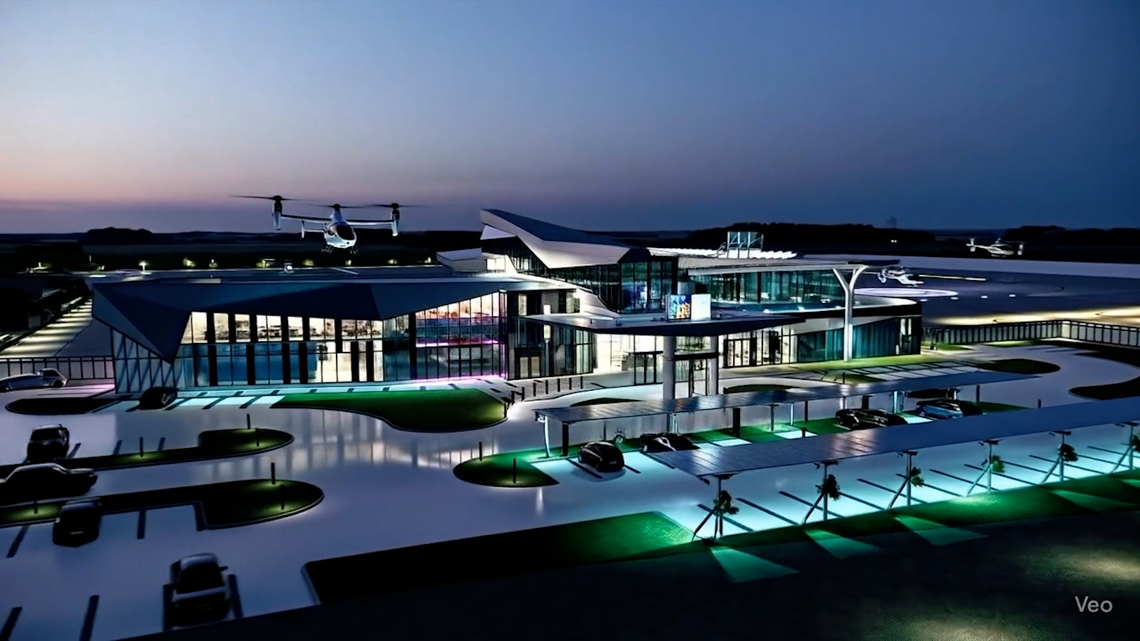
Port San Antonio says the building blocks for so-called “flying taxis” are already beginning to take shape in the city.
SAN ANTONIO — Imagine skipping traffic on I-10 and traveling from the far west side to the Frost Bank Center for a Spurs game in just minutes.
That idea may sound like science fiction, but leaders at Port San Antonio say the building blocks for so-called “flying taxis” are already beginning to take shape in the city.
The aircraft are known as eVTOLs, electric vertical takeoff and landing vehicles. The concept centers on short flights that connect busy parts of a city without ever touching the road.
Port San Antonio President and CEO Jim Perschbach said the infrastructure for this type of transportation starts with something called a “vertiport.”
“So a vertiport is the concept, language is being used for where advanced air mobility aircraft can fly,” Perschbach said. “You know, things people call flying cars or flying taxis. They’re really closer to being flying buses.”
According to Perschbach, a vertiport could function as a larger hub, similar to a park-and-ride, or smaller landing areas near destinations people already visit regularly.
“Or you can think of it as being a much smaller landing pad somewhere like the basketball arena downtown, or a university, or a hospital district, or an entertainment district,” he said.
The idea, he said, is not just about developing the aircraft themselves, but building a network of locations where they could land, recharge and transport passengers.
Perschbach said the concept may feel closer to reality because aircraft and drone activity is already becoming more common.
“Well, you’re going to start seeing these aircraft flying around,” Perschbach said. “In fact, if you keep your eye open, you’ve probably seen them flying already.”
What still needs to be developed, he said, are the systems and regulations needed to safely manage low-altitude flights over urban areas.
Port San Antonio leaders say the city’s aviation and technology workforce makes it a strong candidate to help shape that system.
“Is that you need to have people who understand everything from artificial intelligence to cybersecurity to signals to weather,” Perschbach said.
That work includes collaboration with SkyGrid, a partner focused on developing software to help safely manage “low altitude and complex airspace,” according to officials.
Perschbach said the effort is not only about convenience but could also help improve access to jobs and opportunities.
He pointed to physical barriers, such as large rail yards, that make travel between nearby neighborhoods difficult and costly to address with traditional infrastructure.
“A massive rail yard, building a bridge over it. It’s going to cost nine figures,” Perschbach said. “But if you can just hop people from one side to the other, then it is a lot easier to get to the jobs and the opportunities.”
Supporters say the technology could eventually provide another way to connect people across the city without relying solely on new roads, bridges or parking infrastructure.
Officials acknowledge widespread use is likely years away and early adoption could begin with higher-end users before expanding more broadly.
However, early experimental versions are already being tested. In one example, participants in Austin receive brief training before flying a small single-person craft.
While flying taxis are not expected to replace cars anytime soon, the conversation around infrastructure and airspace management is already underway.
With the technology developing and aircraft beginning to appear in the skies, Port San Antonio leaders say the city is positioning itself to play a role in building the systems behind the emerging industry.
And for a city familiar with heavy traffic, the possibility of cutting a cross-town trip down to minutes is one reason the concept is drawing attention.