
A decade after leaving the classroom to pursue art full-time, Cruz and Olivia Ortiz are now opening their south-side arts oasis.
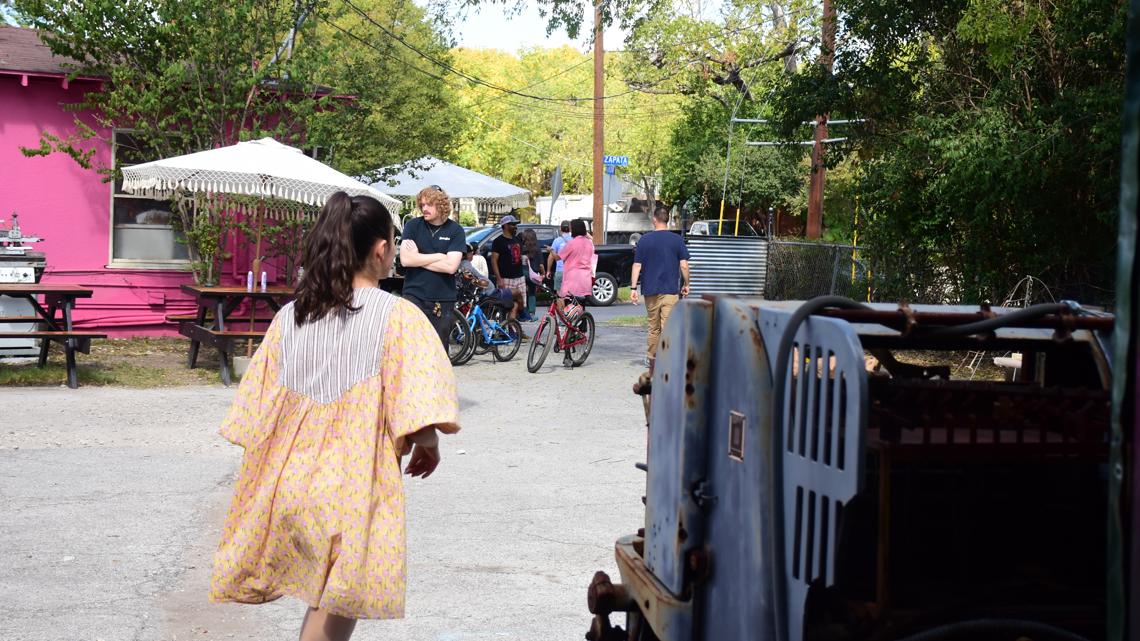
SAN ANTONIO — To understand the intention behind Casa Pink – a new part-coffee shop, part-gallery, part-event space that appears at the end of a quiet south-side block like a flower peeking through a shrub – you must first understand the story of the artists who planted its seeds.
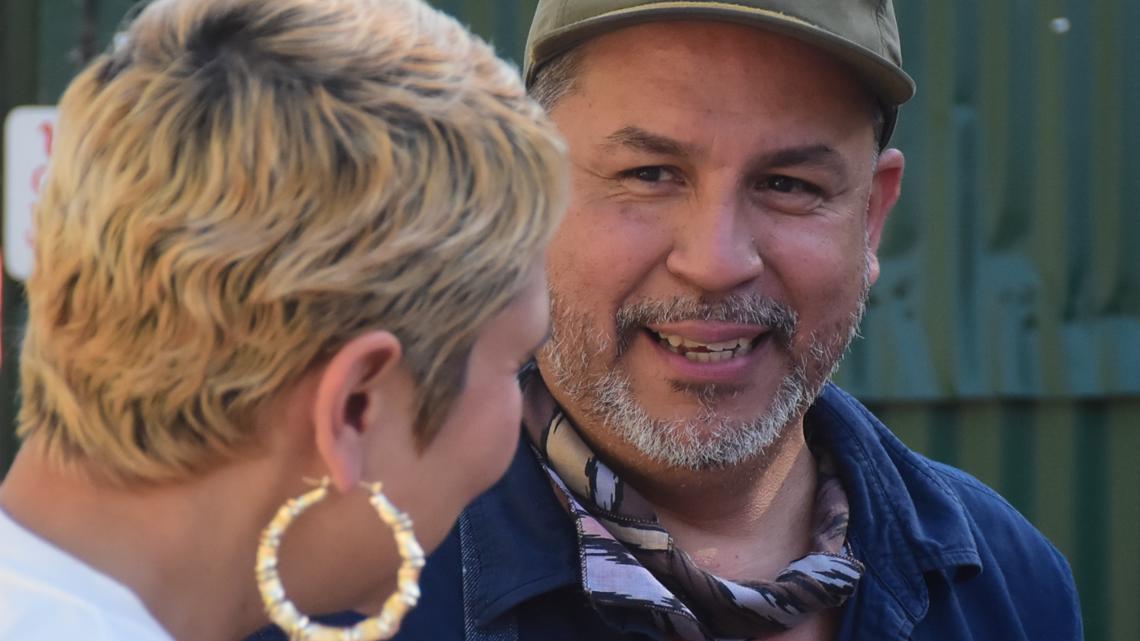
Before they were full-time artists and business owners, Cruz and Olivia Ortiz were teachers at LEE High School in north San Antonio. She taught English; he art.
Or, as Cruz puts it: “I was the grungy art teacher in the basement.”
“I like to say we met in the trenches,” he says now, over a decade later.
The two educators found they had much in common. Today they recall with fondness how students would react when Cruz popped into Olivia’s classroom while they were quietly reading (“Giving me the look like, ‘You’re dead.'”)
What they also shared was a reverence for teaching, for the way they had the freedom to adapt to their students.
Now, they say, “that’s completely gone.”
They can pinpoint where standards began to be watered down: Olivia, who started teaching at 21 years old, recalls once covering the Dickens’ “A Tale of Two Cities”—an epic of dense prose and denser themes.
Suddenly, one day, she found herself teaching only the courtroom climax of the much-shorter “To Kill a Mockingbird.”
“We weren’t even reading from cover to cover,” Olivia said.
“That’s the first gap I saw,” Cruz recalls.
It was also, in a certain respect, the first domino to fall on the way to where they found themselves one warm November morning: Welcoming fellow San Antonians to the grand opening of Casa Pink, a Frida-and-Diego-inspired space the Ortizes have spent years cultivating and are now applying the next coat of paint to.
Metaphorically speaking.
“This is the story of us,” Cruz says. “The story of me and Olivia. Of two people who found each other and want to give back, to open the door.”
An ‘analog’ space
Stepping through the gate at the November grand opening, visitors walked into a property that feels like it reveals new corners to itself the more you explore.
There’s the open-all-week coffee shop staffed by baristas who – as it turns out – are all artists themselves, next to an open space populated by local vendors and music.
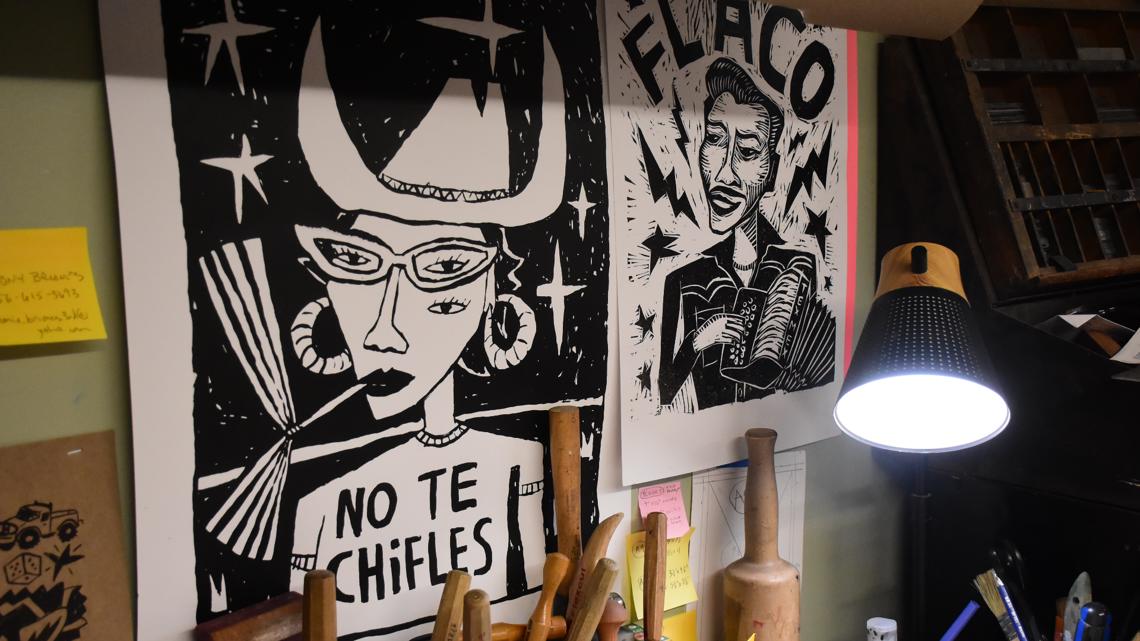
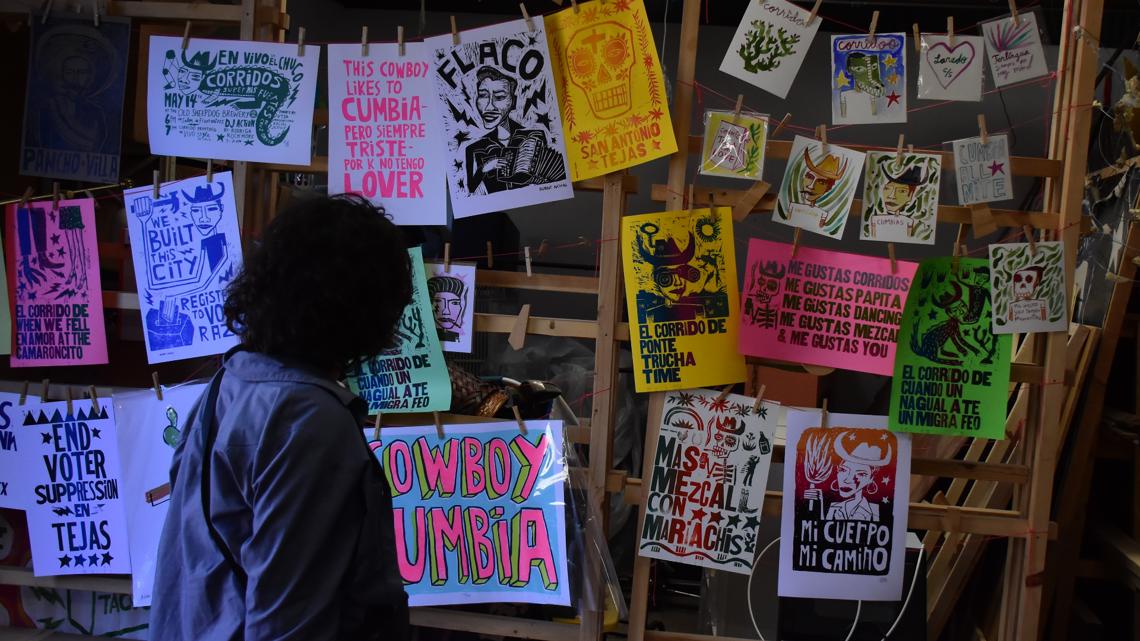
Stroll into the nearby studio and it’s like diving straight into the Ortizes’ artistic process. Puppets hang from the rafters, clay figurines crowd a nearby bench, and the walls are covered with prints and paintings of Cruz’s trademark creations—striking and sharp-angled figures, set against political, cultural or satirical backdrops, whose eyes always look like they’re preparing to witness the next chapter of Texas history, whatever that may bring.


In the back, the husband-and-wife duo has debuted Little Pinky Gallery, where they plan to spotlight local artists through exhibits rotating every three months. A more private patio space is available for rent to anyone who can make use of it—corporations for meetings, musicians for album release parties, lovebirds for wedding events.
“As artists, we typically work out of our house or have a small or shared studio. So to see more of a complex is, I think, ideal for artists who want to grow and have bigger work and make these things,” says Jose Sotelo Yamasaki, an artist whose surreal but personal works of graphite and pastel are currently on display at Little Pinky. “It brings a lot of hope.”
The Ortizes have styled Casa Pink as place for groups to utilize; for young artists to learn the tools of the trade; for those wanting a cup of coffee to stimulate a local community space while sipping.


But they also, more urgently, talk about Casa Pink as an answer to the lingering cracks COVID created in social norms and habits of communication. If the 2020s have thus far been defined by living through remote means and the rise of artificial intelligence, the Ortizes, through Casa Pink, are trying to return to a more organic way of fostering conversation, debate and – this being partially a gallery – art.
“It was very intentional to be analog,” Olivia says.
“We want this to be a place where people get together,” Cruz adds. “I think that’s the core of it—just people coming together in a cool environment.”
After a pause, he says: “…that’s got a lot of art.”

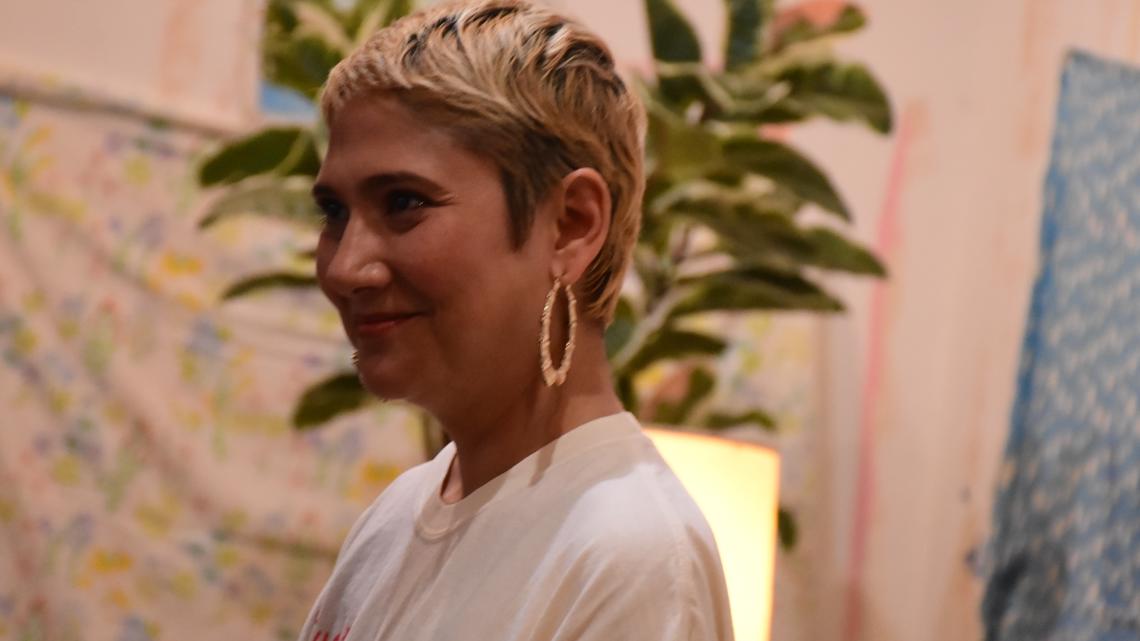
Years in the making
Though they swear they didn’t plan it this way, the opening of Casa Pink comes 10 years after they both put down the grading pens and picked up the paintbrushes, pursuing art as their primary trade and focus.
But it was two years before, in 2013, that another key domino fell. Absolut Vodka approached Mr. Ortiz, art teacher, about the possibility of Cruz Ortiz, artist, designing a special bottle tailored to Latino customers.
That was the first taste of a career he would soon dive into full-time, nudged along by Olivia’s encouragement, who was already a year out of teaching at that point.
“I told him, ‘We can do this ourselves. We have something here,'” Olivia recalls.
In June of 2015, they hit the ground running and haven’t stopped, making careers out of graphic design, painting and printmaking. Their brand Burnt Nopal touts itself as the intersection of Texas-Mexican tradition and contemporary design, and has serviced clients from Arizona State University and local baseball clubs to the San Antonio Missions and political candidates.

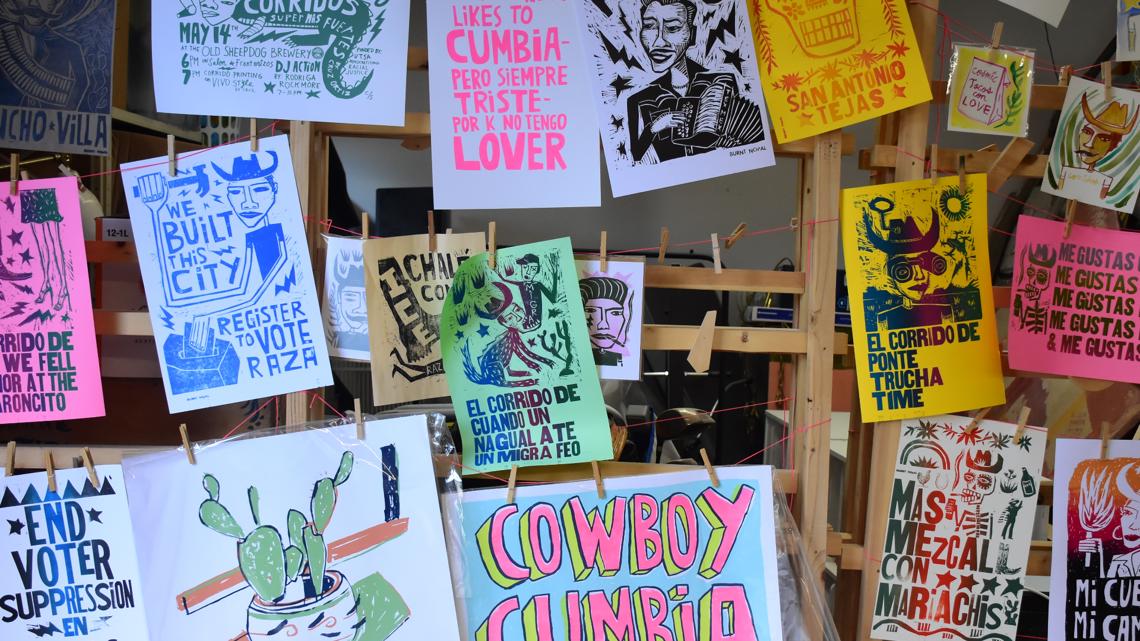
In the last decade, Cruz’s art has been exhibited in New York, Alabama, California and various Texas galleries. Olivia’s work has been seen in Mexico City, Laredo and here in San Antonio.
The fact that their unique south-side blend of home, studio and event space is embarking on the next stage of its evolution 10 years after they ramped up their business gains more resonance considering they nearly left the Alamo City for Houston.
That was early March 2020. The global interruption that was to come eventually showed them another road to take.
It involved staying in San Antonio.
“I don’t think I would be happy,” Olivia now says about if they had gone east. “Even the building we had (bought in Houston) wasn’t this. The community would be different, and I love my community here. I’m so proud to be here.”
The roots were too deep, as they explain it. Now it was time to see what could flower.
What blossomed would turn out to be pink. During the pandemic – while museums, libraries, theaters and cinemas all had to adapt and find new ways for stories to flourish at a moment of deep vulnerability – the Ortizes came up with the concept of Casa Pink.
At the core wasn’t a mission so much as an invitation.
“We narrowed it down to harbor, the idea of education,” Cruz says. “Opening the gate. Not gatekeeping knowledge as artists.”
“(Artists’) heads are down,” adds Olivia, speaking to how they want Casa Pink to be a different kind of studio. “We’re trying to get out the next thing and forget to pull others up.”
PHOTOS: San Antonio art complex is a labor of love for its creators, a ‘harbor of intellectual’
‘Let’s get deep’
It’s not just obstacles of their industry they’re working to bust through; it’s societal perceptions about art, history and the shifting value they carry.
“One of the things we realized is museums are also being threatened. We just tore one down,” Cruz said, referring to the Institute of Texan Cultures, quietly demolished over the course of several months this year against fast-growing plans to build a new Spurs arena in its place.
“That was the one place that told the story of Texas as a complex—multicultural, multi-experience, multilingual, but still function together as a whole community. That’s gone now.”

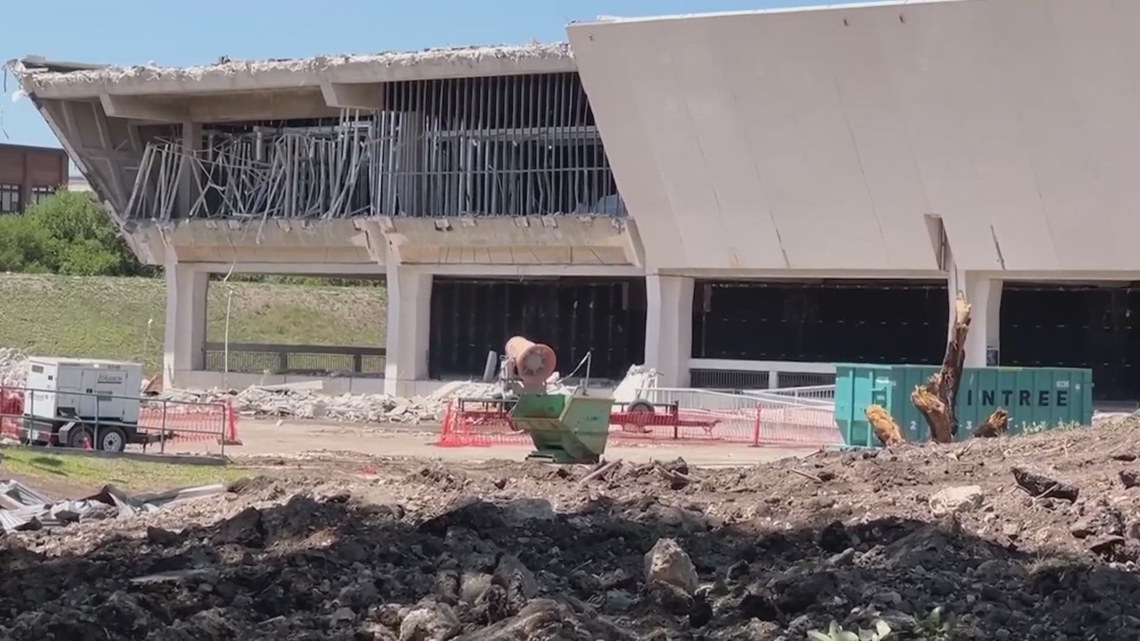
At the same time, grassroots storytelling triumphs like this fall’s opening of the Museo del Westside – which the Ortizes had just visited with an out-of-town group – gives the artists hope.
“Back in the day, every neighborhood had a little tiendita. That tiendita had fresh fruit and bread and milk and water, but it was also a place where people got to talk. It was a hub for the community.”
The partners in business, art and life hope Casa Pink can fulfill a similar purpose. Some artists stopping by for the complex’s grand opening say they already have.
Among them is Yamasaki, who said it represents what’s great about San Antonio: “That we don’t wait around for anybody to open the door for us. You just create the space and open your doors, let people experience it.”
Another full-time artist who works just a few minutes away, Albert Gonzales, said Casa Pink is just the next stage in what San Antonio has continue to be—a close-knit hub for people seeking inspiration from the city’s “puro” culture, whatever that means to them.
“Hearing other people’s perspectives that aren’t from San Antonio, (they’re like), ‘San Antonio has something really unique,'” Gonzales said. “Artists like Cruz and Olivia… they’ve known that and have been fostering that.”
Cruz sums the aim up in simpler terms.
“We’re big thinkers here,” he says. “We’re a harbor for intellectuals. Let’s get deep.”
Studio Coffee at Casa Pink is open seven days a week, from 7 a.m. to 2 p.m. The galleries and studio are open on the weekend. Anyone interested in renting the space for private events can inquire at studio@burntnopal.com.