
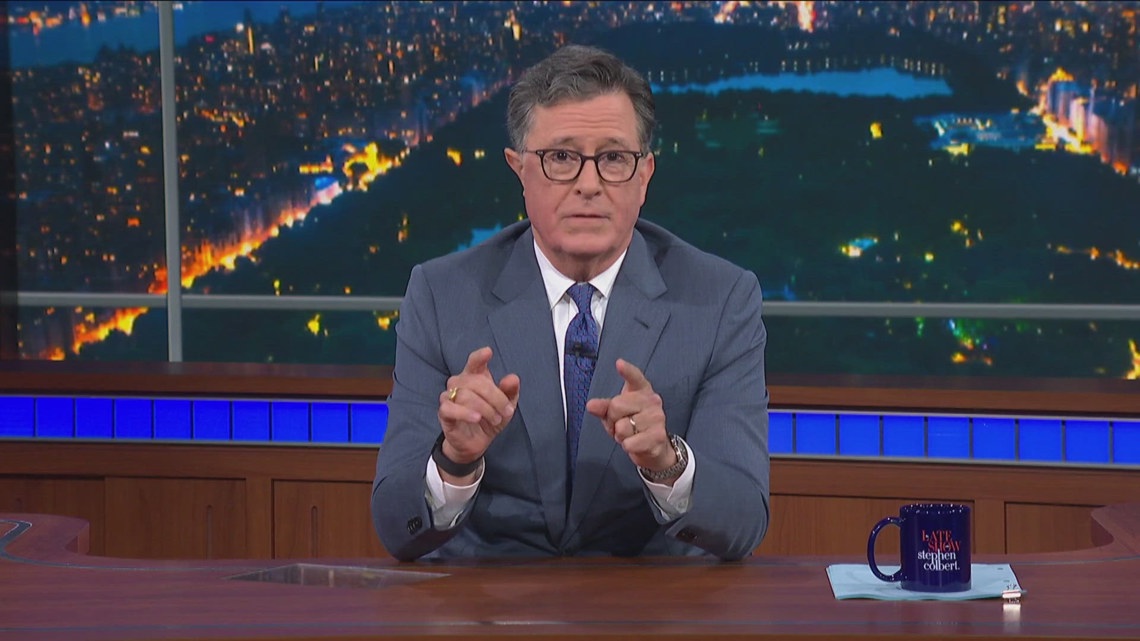
The late-night host said the network feared running afoul of new FCC guidance directing shows to give equal airtime to political candidates.
Late-night host Stephen Colbert accused his network, CBS, of refusing to broadcast his interview with Texas Rep. James Talarico, a Democratic candidate for U.S. Senate, during Monday night’s airing of “The Late Show” for fear of running afoul of the Trump administration.
Colbert said CBS canceled Talarico’s appearance on air in light of guidance issued Jan. 21 by Federal Communications Commission Chairman Brendan Carr, which directed daytime and late-night TV talk show hosts to offer equal airtime to all political candidates running for a given office. Talk shows have long been exempted from these “equal time” rules when conducting “bona fide news interviews,” allowing them to book political candidates without bringing on their opponents.
Talarico “was supposed to be here, but we were told in no uncertain terms by our network’s lawyers, who called us directly, that we could not have him on the broadcast,” Colbert said in a segment explaining the cancelation. “Then I was told in some uncertain terms that not only could I not have him on, I could not mention me not having him on. And because my network clearly doesn’t want us to talk about this, let’s talk about this.”
The interview was set to air on Monday night’s show the day before the start of early voting for Texas’ March 3 primaries. Talarico is vying for the Senate Democratic nomination against U.S. Rep. Jasmine Crockett of Dallas.
President Donald Trump has repeatedly urged the FCC, which approves mergers in the media and telecommunications industry, to crack down on American broadcasters. In his letter, Carr wrote that “programming motivated by partisan purposes” should comply with the equal time rules.
“Let’s just call this what it is: Donald Trump’s administration wants to silence anyone who says anything bad about Trump on TV, because all Trump does is watch TV, OK?” Colbert said. He added that Carr merely said in the Jan. 21 guidance that he was considering dropping the exemption for talk shows.
“He hasn’t done away with it yet, but my network is unilaterally enforcing it as if he had,” Colbert said.
CBS, the FCC and the White House did not immediately reply to requests for comment. CBS is ending Colbert’s show in May, a decision announced in July just days after Colbert criticized the network’s parent company, Paramount, for a $16 million settlement it reached with Trump after the president sued the company for how it edited a “60 Minutes” interview with Democratic presidential candidate Kamala Harris. Paramount, which needed FCC approval of its sale to Skydance Media at the time, said the cancelation was “a purely financial decision.”
In the interview, which was posted on YouTube, Talarico called the guidance by the Trump administration and the decision by CBS to preemptively comply as a “threat to all of our First Amendment rights.”
“Donald Trump is worried that we’re about to flip Texas,” Talarico said. “This is the party that ran against cancel culture, and now they’re trying to control what we watch, what we say, what we read. And this is the most dangerous kind of cancel culture — the kind that comes from the top.”
Talarico noted that the FCC opened an investigation into ABC’s “The View” after he sat for an interview this month, casting it as part of a pattern of government overreach dating back to when the agency “went after” Jimmy Kimmel for a joke he made about the assassination of conservative activist Charlie Kirk. Kimmel’s show was briefly suspended by ABC in September after the FCC threatened the network.
Talarico added that CBS canceled Colbert’s show after the late-night host told “the truth about Paramount’s bribe to Donald Trump.”
“Corporate media executives are selling out the First Amendment to curry favor with corrupt politicians, and a threat to any of our First Amendment rights is a threat to all of our First Amendment rights,” he said.
The interview also covered Talarico’s Christian faith, Democratic hopes of retaking Texas this year and recent blowback Talarico faced for allegedly referring to Colin Allred, a former Dallas congressman and Democratic Senate candidate, as a “mediocre Black man.” Talarico said he called Allred’s campaigning mediocre but “would never attack him on the basis of race.”