
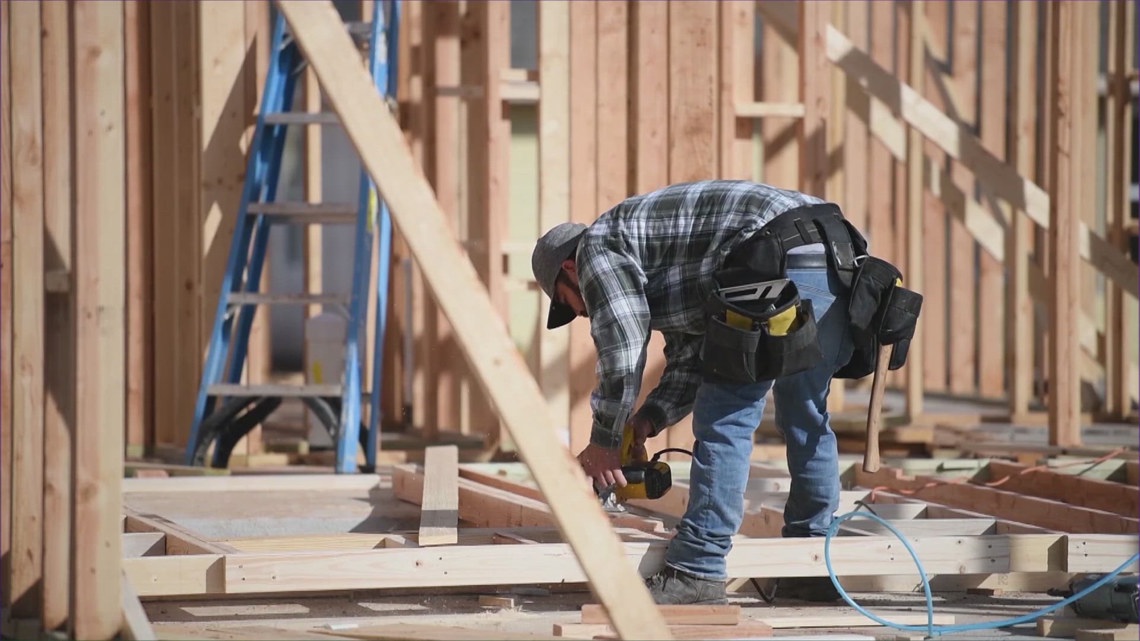
The industry is now turning to lawmakers in hopes of balancing immigration enforcement with workforce realities.
AUSTIN, Texas — Texas construction leaders say increased immigration enforcement is upending their industry. The raids Immigration and Customs Enforcement (ICE) agents have carried out and the fear of more are having a chilling effect, forcing some projects to slow down. Construction leaders are now turning to elected officials for help in changing immigration laws.
“There’s a bunch of fear in not just the workers, but also the community,” said Mario Guerrero, the executive director of the South Texas Builders Association.
Across Texas, increased immigration enforcement is causing workers, even those with proper documentation, to be scared to go to work. As they steer clear of job sites, it is leading to labor shortages in industries like construction and restaurants.
Typically, it would take anywhere from three to four months to build a basic, 2,100-square-foot home with a two-car garage and about 1,600 square feet of living space. Now, Guerrero said it takes nine to 11 months.
“Time is everything, especially in the construction industry, and when you’re trying to figure out your logistics on time, on how you’re going to be moving a project, and now you have to take this into consideration and there’s no workforce,” Guerrero said.
The Rio Grande Valley is among the hardest-hit areas. The Texas Tribune recently reported that ICE has made 9,100 arrests in South Texas, nearly one-fifth of the total arrests statewide.
As the immigration officials have gone about doing their jobs, Guerrero said he has found it disturbing how ICE has been operating. In some cases, they detained people who do have proper documentation to be in the country. ICE does not need judicial warrants to make arrests.
“It would be one thing if they’re showing up with a warrant, and a judge signs that warrant, and they’re saying, ‘Hey, I’m looking for X, Y and Z. We have a warrant to look for this person,’” Guerrero said. “But that’s not what’s happening when they’re showing up and they’re questioning everybody, even if you do have proper documentation.”
According to the Federal Reserve Bank of Dallas, the Rio Grande Valley saw a 5% decline in construction jobs in the third quarter of last year, the largest among major regional industries.
Guerrero and the South Texas Builders Association have been increasingly vocal about their frustration and concerns about the challenges facing the construction industry due to the ongoing ICE raids.
The construction industry is suffering as a result of the ICE raids because of its heavy dependence on immigrant labor, meaning there is not a large, extensive workforce to supplement the industry immediately.
According to the American Immigrant Council, in 2022, more than 507,700 immigrants worked in the construction sector, representing 40% of all industry employees. Of these workers, the AIC said approximately 295,400 were undocumented, which represents 23.3% of all employed workers in the industry.
“We have a system in the United States that has failed us to prepare a proper workforce for our communities,” Guerrero said. “When we are in high school or middle school, they never actually tell us or teach us that to be a framer, to be a roofer, to be an electrician, any trade is a good thing. They always want to push us into college, which is great, but the system has failed to provide a proper workforce for us.”
Without enough workers and construction projects slowing, there is a ripple effect throughout the entire economy, and with less of a housing supply, some economists say it could drive up housing costs.
A study of an immigration enforcement program from 2008 to 2023 found that it led to a 2% to 3% drop in construction workers, which cut new home construction by nearly 6% and led to higher home prices.
Guerrero said it is already having a significant impact on the local economy, such as a Mexican restaurant chain in the Rio Grande Valley that has seen a 50% decrease in sales.
“If this administration continues on this path for another year, it will really impact the economic outlook on the Valley – and not just the Valley; I believe it also affects San Antonio, Dallas and Houston,” Guerrero said. “It’s not sustainable.”
Guerrero said his industry needs help, so they’re turning to lawmakers in hopes of balancing immigration enforcement with workforce realities.
“We’re advocating for peace at our job sites, and that’s all we’re asking,” Guerrero said. “We’re not asking for you not to do the raids. We’re just asking: Please don’t do it at our job sites where you have low-hanging fruit.”
After meeting with U.S. Rep. Henry Cuellar (D-Laredo), the group met with U.S. Rep. Monica De La Cruz (R-Edinburg) last week. Afterward, the Republican said she would meet with the U.S. Department of Labor to look at ways to allow migrants to work legally in the construction industry.
De La Cruz expressed support for a visa program for construction workers, similar to the H-2A visa program already in place for agriculture workers.
“My top priority is to hear from South Texans and deliver solutions to ensure our communities remain prosperous,” De La Cruz said. “I will continue to focus on what matters: delivering common-sense policy solutions for the hard-working immigrants who strengthen our communities and making homeownership affordable for all Americans.”
In September, Pennsylvania Republican U.S. Rep. Lloyd Smucker introduced legislation that would create a new visa category for nonagricultural workers.
De La Cruz introduced a bill last year that would make changes to the H-2A visa program by streamlining the application process for agricultural workers, set the wage rate for workers at the state’s minimum wage plus $2.00 per hour and extend H-2A contracts from 10 months or less to 12 months. It has not yet been put to a vote.
Guerrero said it is not just about getting help for solving the issues that the construction industry is facing, but also learning their rights when one of their construction sites is targeted by ICE officers.
“We’re actually trying to figure out what laws, if any, apply to the immigration raids that we’re seeing at construction sites,” Guerrero said.
During a visit to the border on Friday, U.S. Sen. John Cornyn (R-Texas) said he believes that lawmakers should wait until the border is “completely secure” to make changes in immigration laws.
“There is no way that the American people, certainly my constituents in Texas, would allow us to take another stab at reforming our immigration laws until we get the border secure,” Cornyn said.
Once the border is “secure,” Cornyn said the country needs to complete the process “of removing people who shouldn’t be here in the first place,” before lawmakers can dive into changing immigration laws.
During that news conference, Senate Majority Leader John Thune (R-South Dakota) said he is open to legislation that would address the worker shortage once the border is “secure.”
“I think we can work in a constructive way on how we come up with a mechanism whereby people who come to this country legally can contribute and be members of our workforce,” Thune said.
As elected officials debate solutions, local leaders like Guerrero are doing what they can to keep projects staffed and on track, as communities continue to grow.