
Victor Wembanyama, De’Aaron Fox and company are on pace to win 24 more games than last year. Where would that turnaround rank in franchise history?
SAN ANTONIO — It’s no secret the Spurs are soaring this year. Some might even say they’re overachieving.
Just look at their ever-growing national TV slate and the five – count ’em, five – representatives they sent to NBA All-Star Weekend festivities, a number that doesn’t even include Mitch Johnson, San Antonio’s head coach who won All-Star Game coaching rights in his first full season at the reins.
Entering the All-Star break, San Antonio had the No. 2 seed in the tough Western Conference locked down. Fewer games separate them and the defending champion Oklahoma City Thunder than the Denver Nuggets, who sit at No. 3.
At 38-16, the Spurs already have four more wins than they’ve had in any full season this decade so far. If they finish the season at that pace, Victor Wembanyama and company would end with a 58-24 mark (though, to be clear, that doesn’t take strength of schedule into account, and anything can happen with injuries).
Fifty-eight wins would give the Spurs a 24-win improvement over last season, amounting not only to a remarkable turnaround, but one of the biggest jumps up the win totals chart in franchise history as Wembanyama ascends to the NBA’s elite, Stephon Castle continues carving out his All-Star potential, and young studs Dylan Harper and Carter Bryant continue flaunting their confidence.
Peek back at Spurs history and you’ll find that the organization’s biggest turnarounds were built on similar narratives. Read on to learn more about the Spurs teams that did the most on the court when the chips on their shoulder were at their largest.
1997-1998: 56-26 record, 36-win improvement
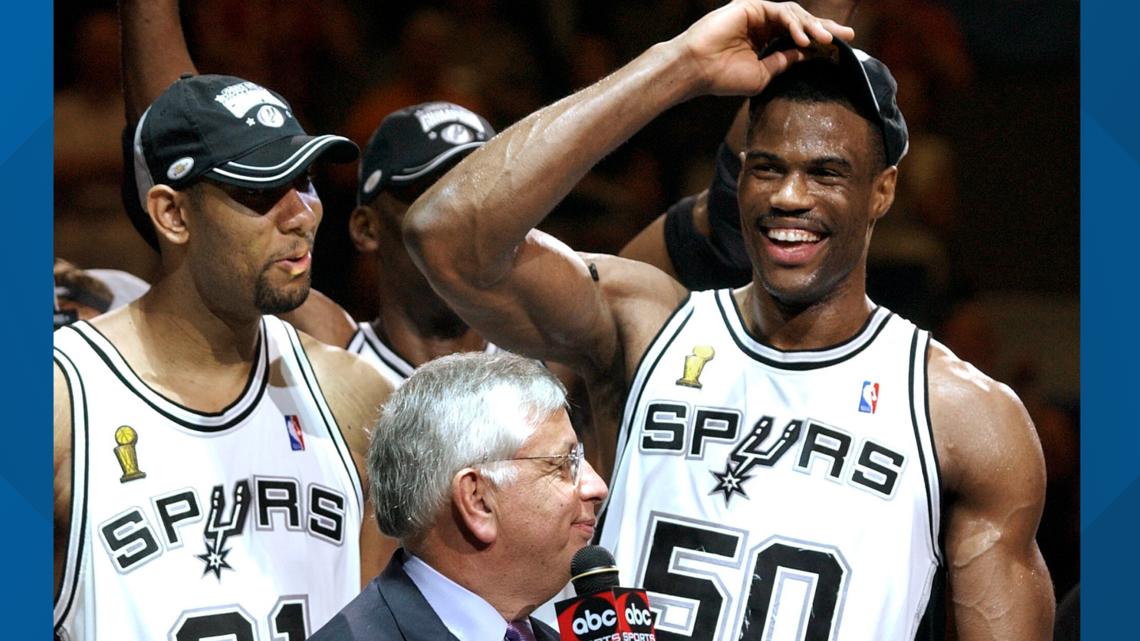
Perhaps it should come as no surprise that the biggest year-to-year improvement is the comeback where the Spurs added a future Hall of Famer and saw another return to the court after he was sidelined most of the previous year.
David Robinson, who by this point had cemented himself as one of the NBA’s elite after winning MVP honors in 1995, played just a handful of games in the 1996-’97 season en route to an overall 20-62 team record. San Antonio won the Draft Lottery in the summer of 1997 and the rights to draft megahyped prospect Tim Duncan, and the rest is history: With Robinson back and Duncan putting on a show worthy of the eventual Rookie of the Year winner, the Spurs rocked their way to a 56-26 record and a first-round victory over Phoenix in the playoffs.
They would fall to the eventual Finals participant Utah Jazz in the conference semifinals, but the organization had started paving its road to success. The following season brought the organization its first of five NBA championships.
1989-1990: 56-26, 35-win improvement
San Antonio won just 21 games in the 1988-’89 campaign, the third-worst record in the West.
Enter David Robinson.
After drafting him No. 1 overall in the 1987 NBA Draft, the Spurs had to be patient as The Admiral completed his naval service. The wait was worth it: The Spurs rode a 32-14 start to a final record of 56-26 as Robinson (24.3 points, 3.9 blocks, 12 rebounds per game) kicked off a tradition of Spurs No. 1 picks winning Rookie of the Year honors. Not for nothing, the Spurs also drafted future franchise great Sean Elliott with the third overall pick before this campaign; he kicked off his NBA career averaging 10 points, 3.7 rebounds and 1.9 assist per game his rookie year.
With their core of Robinson, Elliott, Willie Anderson and Terry Cummings, San Antonio won its first playoff series in seven years, a first-round sweep of the Nuggets. They took the Trail Blazers to a full seven games in the conference semis, but lost Game 7 on the road in OT as Terry Porter scored 36 for Portland.
1999-2000: 53-29, 16-win improvement*
There’s a reason for that asterisk: 1998-’99 was a lockout-shortened season, and though the Spurs won 16 games more the following year, they technically had a worse winning percentage (.646 to .740). San Antonio met Phoenix in the playoffs for the second time in three years, having beaten the Suns in the first round of the 1997-’98 postseason.
This time the Suns got their revenge, besting the Spurs in four games in the first round.
2015-2016: 67-15, 12-win improvement
On the one hand, the 2014-’15 Silver & Black were a darn good squad.
Coming off their NBA Finals revenge mission against the Heat, that squad still boasted the Big 3 of Tim Duncan, Tony Ginobili and Tony Parker, as well as young studs in Kawhi Leonard and Danny Green. They played their way to an impressive 55-27 record and Defensive Player of the Year honors for Leonard.
But the following year, San Antonio put it all together and took their play to another level. Helped by offseason acquisitions LaMarcus Aldridge and David West, the Spurs finished with their best mark in franchise history while tying the NBA record for most home wins after roaring to a 40-1 mark in San Antonio.
The Warriors, who finished with a historic 73-9 record, were the only team to finish ahead of the Spurs in the Western Conference. And though the sports world might have been anticipating a clash between the two teams in the conference finals, it wasn’t to be—San Antonio faltered to a flamethrowing Kevin Durant and the Thunder in a second-round matchup that went six games.
The Spurs lost that series 4-2, and have won just two playoff rounds ever since.