
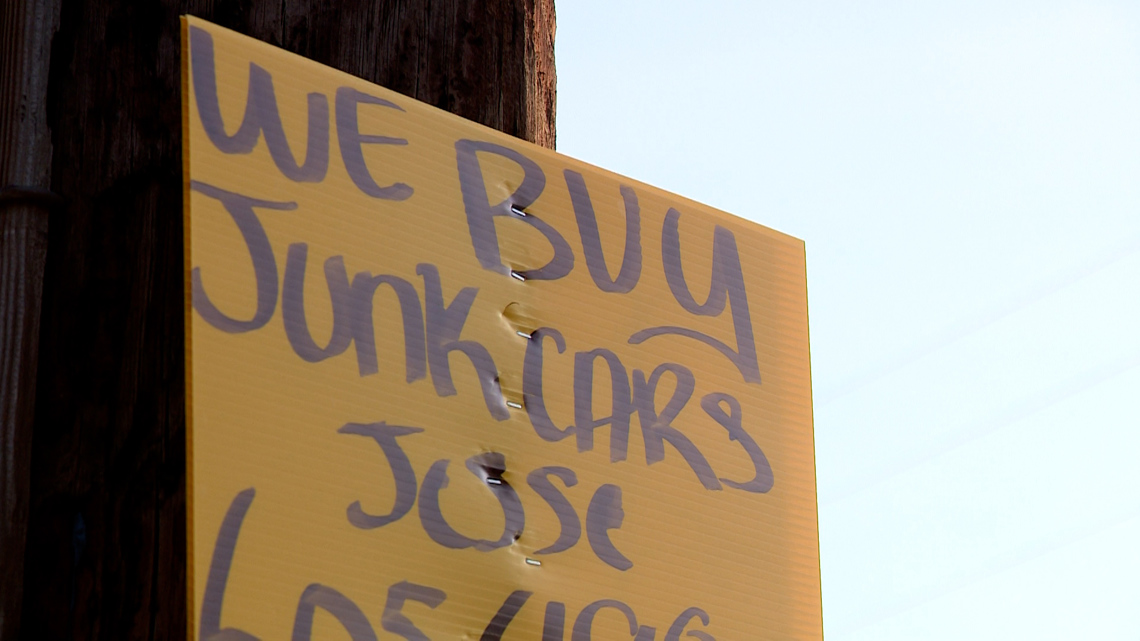
“We buy ugly houses,” junk car, and job signs clutter San Antonio streets. They’re already illegal — and a new Texas law adds tougher fines to stop repeat offenders.
SAN ANTONIO — They appear overnight, staked into medians, taped to poles and planted at busy intersections across the city.
The handwritten signs advertise quick cash, houses for rent, or job offers. They’re known as “bandit signs” — and in San Antonio, they are illegal the moment they are placed in a public right-of-way.
City ordinance considers bandit signs placed on medians, sidewalks, street corners and other public rights-of-way to be trash. Unless a sign has a valid city permit, it is not allowed.
Despite that, enforcement has long been a challenge.
San Antonio’s Development Services Department, Code Enforcement Section, tells us officers remove bandit signs proactively when they see them and also respond to citizen complaints through 311. On weekends, volunteer teams including Code Enforcement officers fan out across the city to remove signs.
However, officials say issuing citations or filing criminal cases can be difficult.
Phone numbers listed on the signs are often burner phones, signs are cheap to manufacture, and enforcement typically requires catching someone in the act. City officials say while citations can be issued, tracking or penalizing repeat offenders is especially challenging for those reasons — a major reason they’re called “bandit” signs.
Jason Vasquez, president-elect of the Jefferson Neighborhood Association, says the signs are a constant issue.
“I call it one of my passion issues,” Vasquez said. “They’re on every corner in every district — but especially in my neighborhood.”

Vasquez says the signs don’t just clutter streets — they can raise concerns.
“They’re just a lot of visual clutter. Sometimes they’re scams,” he said. “It’ll be a fix and flip or some kind of scam. More than anything, though, it’s just a blight on the neighborhoods.”
Vasquez says he sees the same signs return to the same locations again and again — including along Fredericksburg Road, Hildebrand Avenue and access roads near Interstate 10. Recently, he’s noticed some signs being placed higher on poles to make them harder to remove.
“To where you and I can’t just take them down — you’ve got to get them on a ladder or something,” he said.
Now, a new Texas law aims to close enforcement loopholes.
House Bill 3611, which took effect September 1, 2025, strengthens enforcement by targeting not only the people who physically post the signs, but also the businesses and advertisers benefiting from them. The law requires written notice for a first violation, giving violators a chance to remove the sign, but introduces clear, escalating civil penalties for repeat violations. Fines can range from $1,000 for a first violation, $2,500 for a second and $5,000 for a third or subsequent violations.
The state law does not replace local ordinances — it strengthens them.
San Antonio Code Enforcement confirms residents are also allowed to remove bandit signs themselves, at their own risk. The city notes it and public utilities are not liable for damage, loss or injury related to those independent actions.
For those who prefer not to remove the signs, residents can report them anonymously by calling 311 or using the City’s 311 app.
Vasquez says empowering residents is key.
“A lot of residents need to be made aware that they are empowered to take them down on their own,” he said.
He says he often removes signs himself — sometimes repurposing the metal stakes for his garden.
“I just ask Code to step it up and help out with making our neighborhoods beautiful and making sure they remain the wonderful places they are.”