
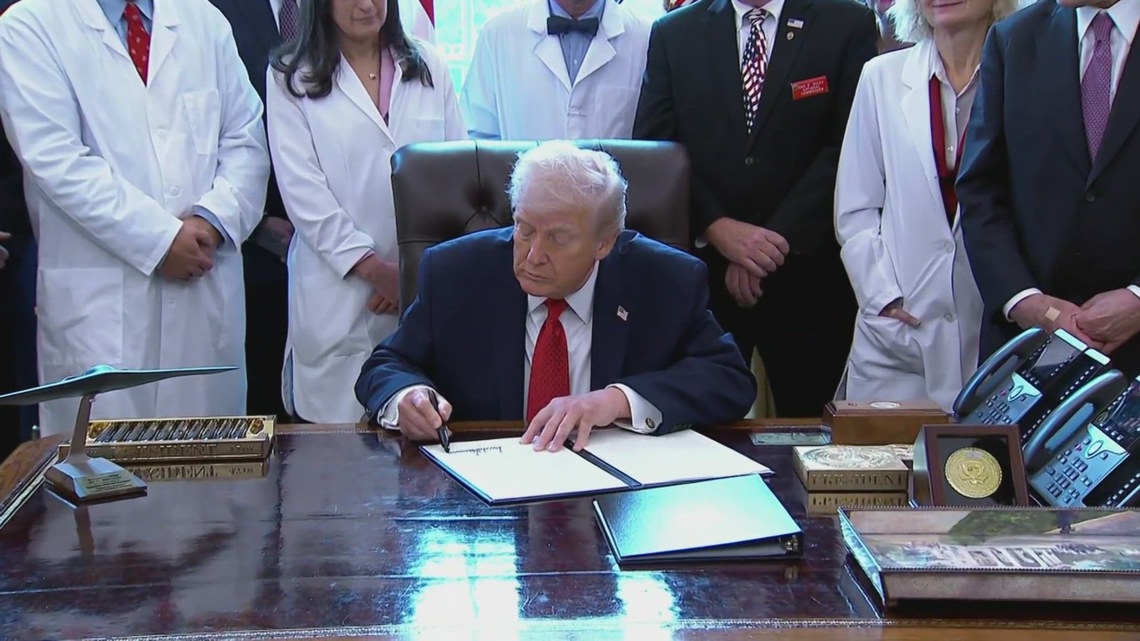
The president signed an executive order this week rescheduling marijuana from Schedule I to Schedule III under the Controlled Substances Act.
SAN ANTONIO — President Donald Trump has reclassified marijuana under federal law, a move industry leaders say could have long-term implications for Texas’ growing medical cannabis program.
President Trump signed an executive order this week rescheduling marijuana from Schedule I to Schedule III under the Controlled Substances Act. Schedule I substances are defined as having no accepted medical use and a high potential for abuse, including heroin and LSD. Schedule III drugs are considered to have a low to moderate potential for dependence and include substances such as ketamine, anabolic steroids and medications containing codeine.
Industry leaders say the decision represents one of the most significant shifts in U.S. drug policy in decades.
“I mean, I can’t understate how monumental this decision is for the industry,” said Jervonne Singletary with Goodblend, one of Texas’ three licensed medical cannabis providers operating under the state’s Compassionate Use Program.
Texas lawmakers recently expanded the Compassionate Use Program, allowing more patients to qualify for medical marijuana treatment. Singletary said the federal reclassification further legitimizes an industry that has spent years advocating for recognition as a medical treatment.
“For over a decade, you’ve been fighting for legitimization — saying this is an actual source of medicine and that we help patients,” Singletary said. “This executive order really does put the wind in our sails and legitimizes the industry further.”
Singletary said the change could open the door to expanded research and ease federal tax burdens for cannabis companies. However, the move does not legalize recreational marijuana at the federal level.
San Antonio attorney Joe Hoelscher said marijuana remains illegal under Texas law, where it is classified in Penalty Group 2. Still, he said low-level possession cases are rarely prosecuted in Bexar County.
“For a variety of legal, practical and scientific reasons, that law is essentially ineffective,” Hoelscher said, adding that lawmakers have struggled to enforce consistent cannabis policies.
Hoelscher believes the federal reclassification sends a broader signal about the future of marijuana regulation.
“I think there’s some hope for a coherent national policy that wouldn’t be reliant on every state and their own whims,” he said.
Singletary said moving marijuana out of Schedule I corrects what he believes was a long-standing misclassification.
“It never deserved to be categorized as more dangerous than cocaine or heroin,” he said. “That is a win.”
The decision is not expected to significantly impact the hemp industry, which faces a potential federal ban on THC products derived from hemp in November 2026.