
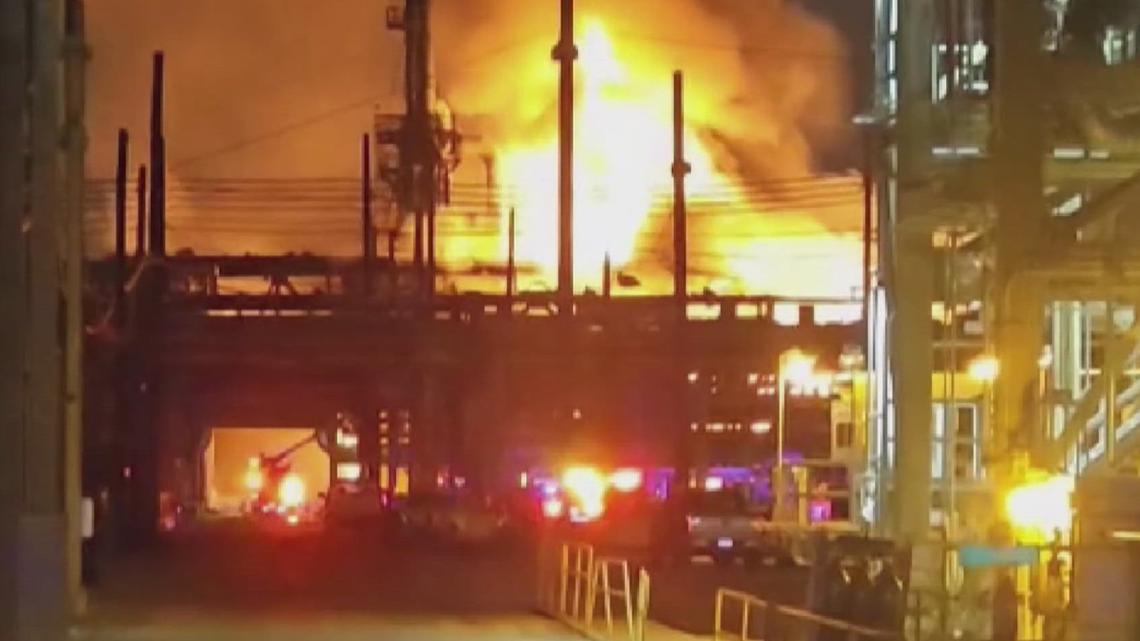
A state report reveals Valero’s refinery explosion in Port Arthur led to significant emissions, prompting a 12-hour shelter-in-place order for nearby neighborhoods.
PORT ARTHUR, Texas — A state report filed Tuesday evening gives the clearest explanation yet for the explosion and fire people across Port Arthur experienced Monday night. In an initial emissions event report filed with the Texas Commission on Environmental Quality, Valero says an “unforeseeable release of process fluid in Complex 2” led to an ignition event and multiple process unit upsets.
Valero says some kind of petroleum based material was released in one part of the refinery, ignited, and then disrupted multiple major units, including the crude distillation unit, diesel hydrotreaters, fluid catalytic cracker, hydrocracker, hydrofluoric alkylation unit and sulfur recovery units. Those are some of the refinery’s core systems used to transform raw crude oil into high-value consumer products like gasoline, diesel, and jet fuel.
“Emergency crews responded immediately and worked to extinguish the fire,” Valero wrote in the report. “Multiple process units were shut down per procedure to minimize emissions.”
The report identifies the incident as an emissions event, not just a fire.
One of the largest entries is tied to “DHT 243 fugitives,” a term commonly used for emissions that escaped from equipment like valves, pumps, connectors or leaks rather than being routed through a stack or flare.
At that source, the report shows emissions above the state permitted levels, including more than 15,000 pounds of particulate matter, more than 6,000 pounds of carbon monoxide, and about 900 pounds of VOCs.
These chemicals can irritate eyes and lungs or make it hard to breathe but it’s unclear from the report if there were any offsite impacts.
The report shows thousands of pounds of sulfur dioxide, along with smaller amounts of hydrogen sulfide and VOCs, were also released through several flares and SCOT units, which are systems designed to handle gases during refinery upsets and reduce emissions before they are released.
Officials kept much of the west end of Port Arthur under a shelter in place for about 12 hours after the explosion, a zone stretching more than two miles from the refinery into neighborhoods as far east as Stilwell Blvd. EPA records show 2,767 people live within one mile of the site, including 976 minors and 388 seniors.
The same report shows 71 percent people of color and 37 percent low income within that one mile radius.