
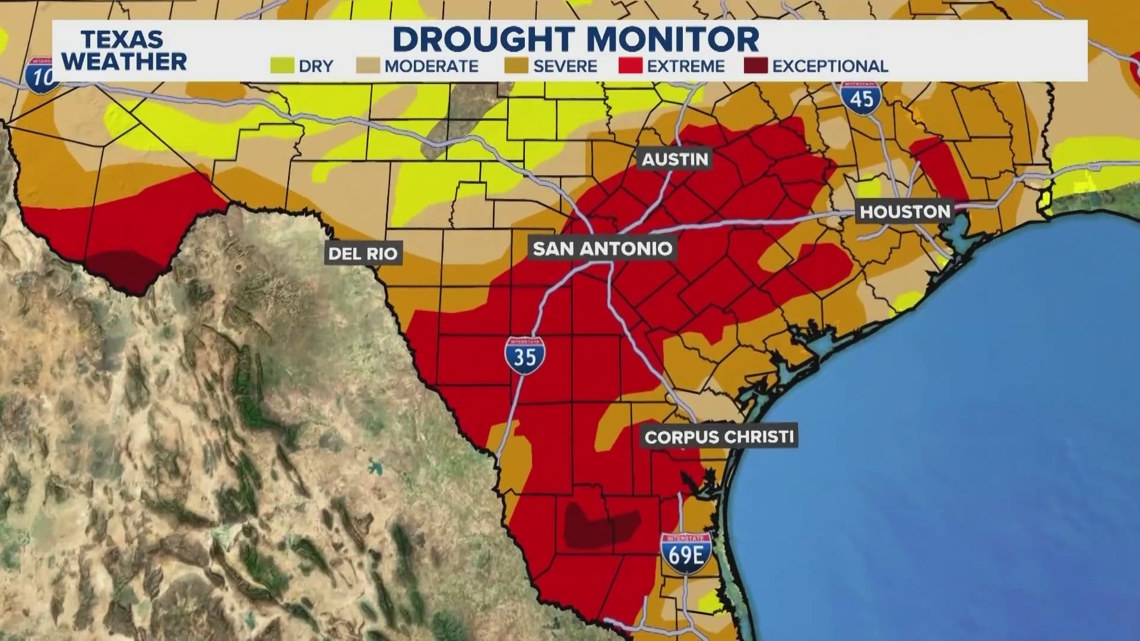
Drought conditions across South-Central Texas are stretching into another year.
SAN ANTONIO — The drought conditions across south central Texas are stretching into another year, and while dry weather isn’t unusual here, the length and intensity of this stretch are raising concerns. Meteorologist David Guerrero explains how this drought compares to the past.
Since 2022, much of south central Texas, including San Antonio, had been experiencing persistent drought conditions. So why is this happening?
It’s mostly because of a stubborn weather pattern parked over Texas that has been limiting storm systems and rainfall north and east of south central Texas.
Richard Tinker, a drought specialist from the Climate Prediction Center, also attributes the drought to the consistent weather pattern of La Niña.
“We have had what they call La Niña conditions,” he said. “When that happens, you lose a source of moisture transport from the central Pacific. When this circulation weakens, then you have less moisture in the region.”
As a result, we have fewer widespread soaking rains that would have provided the necessary relief from our drought.
And then there’s the heat. Temperatures have consistently run above average over the past several years. That increases evaporation, dries out soil faster, and worsens drought impacts.
“And so because of the high temperatures too, compared to other parts of the country, it’s easy to lose surface moisture,” Tinker said.
The longest drought since the creation of the Drought Monitor in 2000 was a 4 1/2 year stretch that began in 2011 and ended in 2016. However, the drought in the 1950s that lasted more than six years and reshaped water planning across Texas has been cited as the worst in Texas history.
While the current drought has not yet surpassed that event, it is now among the longest sustained dry periods in recent decades, and unfortunately, there is no foreseeable end in sight.
“This one’s going to continue to go on, it looks like for some time,” Tinker said. “We have a drought outlook, and the outlook for the next one to three months is not particularly favorable for the region.”