
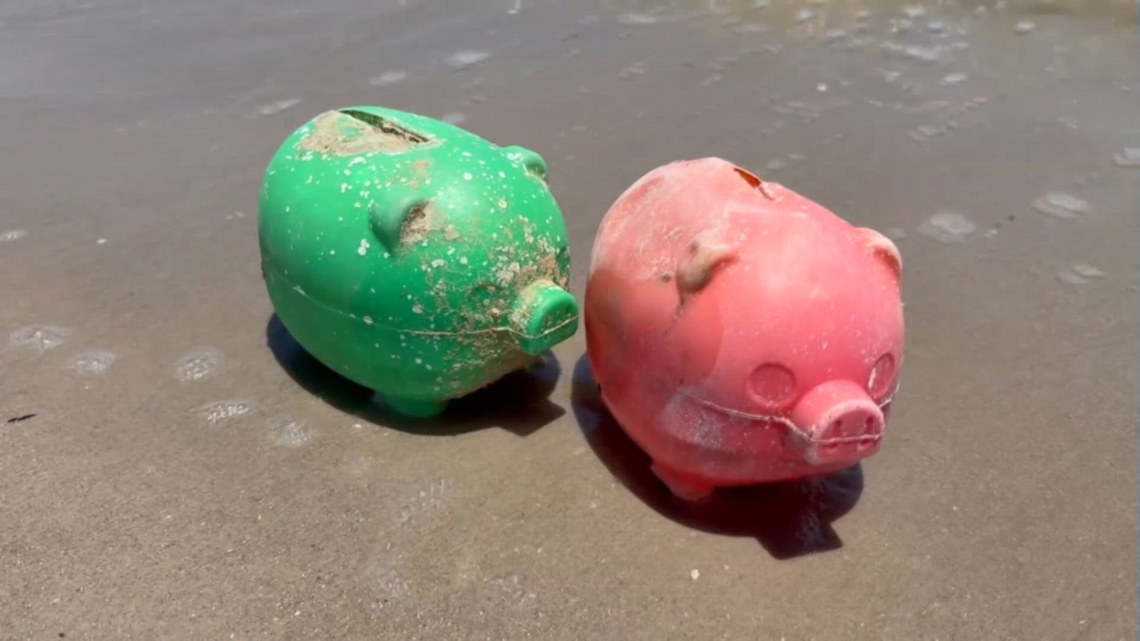
Plastic piggy banks are mysteriously washing up on Texas beaches — and a local marine scientist says they reveal how far ocean trash can travel.
CORPUS CHRISTI, Texas — What started as an unusual beach discovery is now giving scientists a glimpse into how far floating trash can travel through the Gulf.
For years, Jace Tunnell has walked beaches across the Coastal Bend searching for marine debris and documenting what washes ashore. In that time, he says he has found just about everything imaginable.
“If you can think of it, we’ve found it out here,” Tunnell said.
Among the strangest discoveries over the years: more than 60 messages in bottles, a safe, a prosthetic leg, bowling balls and even boats he says drifted from Cuba.
“I found over 60 messages in a bottle … a safe. I found a prosthetic leg. I found three bowling balls … boats washed up from Cuba,” Tunnell said. “I found a 35-foot sailboat with the mast still up, the sails up.”
But recently, a new item started appearing along local beaches in surprising numbers: plastic piggy banks.
“We have a couple of different species, you know, as we say in science,” Tunnell joked.
According to Tunnell, he once found as many as 14 piggy banks in a single day.
The colorful plastic banks appear to come from several different countries. One of the most common versions was manufactured in the Dominican Republic, while others include Spanish writing and at least one had markings from Guatemala.
“This is the most common one we find and it is made and manufactured in the Dominican Republic, so that’s probably a good place to start is in the Caribbean,” Tunnell said. “A lot of these are coming from now we have found some other ones that have Spanish writing on them. We have one that says Guatemala.”
Tunnell said reports of the piggy banks have come from beaches up and down the Texas coast, stretching as far north as the Bolivar Peninsula and as far south as South Padre Island.
At first glance, the unusual discovery might seem like the result of a cargo spill or container ship accident, which Tunnell says may explain the ones that haven’t been pierced. However, he believes the explanation for the majority of them is likely less dramatic.
“Once these piggy banks have been used, you’ll notice there’s a bunch of cuts in them. There’s no other way to get the money out, so people dispose of them, whether it’s directly in the ocean or on land,” he explained.
Because the plastic banks are lightweight and buoyant, they can easily enter waterways and eventually drift long distances through ocean currents.
“Once it rains, these things are real lightweight. They float. They get into the waterways like rivers, float to the ocean, get into that loop current, and get into those eddies and push up to the Texas Coast,” Tunnell said.
Tunnell encourages anyone who finds one on the beach to dispose of it properly — or even take it home as a souvenir.
Just don’t expect to find any cash inside.
“Every time I post one, people are like, ‘What was in there? Did you find any money?’” Tunnell said. “I just tell them, sand dollars. That’s the only thing I ever found in there.”