
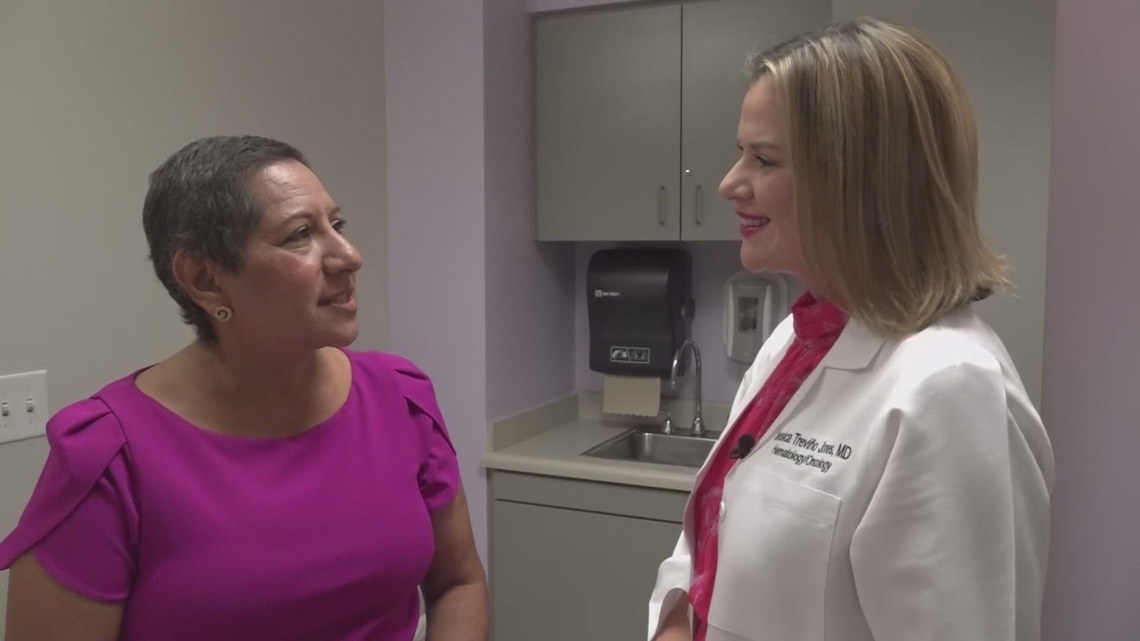
The findings were presented at the San Antonio Breast Cancer Symposium, the largest breast cancer conference in the world
SAN ANTONIO — Three FDA breakthrough approvals for breast cancer treatments presented at the San Antonio Breast Cancer Symposium are offering new hope for patients battling both early and late-stage breast cancer.
All three drugs have been used in clinical trials in the past, but typically for those in later stages of breast cancer when patients have fewer options left. But now, with these approvals, the drugs can be used in earlier stages of the disease like stage two and three, allowing for much better outcomes for patients.
“We are extending their life longer, but also extending their life in a way with less toxicity from the medicines that we’re giving. So they have both a longer life but a better quality of life,” said Dr. Kate Lathrop, associate clinical professor and breast medical oncologist at UT Health San Antonio’s Mays Cancer Center and program director for the San Antonio Breast Cancer Symposium.
More breakthroughs are needed for the one in eight women in the U.S. that will develop breast cancer in their lifetime. Data shows it is the second-leading cause of cancer-related deaths in women – with about 42,000 women dying every year from the disease.
The first medication approved is Datroway, for adults with triple negative breast cancer, which went from research to patient care in just a few months.
“It delivers the medication directly to those cancer cells. So it’s both more effective and potentially less toxic because it avoids some of the normal cells being damaged by chemotherapy,” Dr. Lathrop said.
The second, Enhertu, aimed at shrinking or eliminating cancer before surgery, is already being used on patients with metastatic or late stage breast cancer.
“For women who got Enhertu before surgery, in combination with some chemotherapy and other Enhertu directed medicines, the response of the cancer was much better compared to what we’ve been using for about the last ten years,” Dr. Lathrop added.
The third breakthrough also involves Enhertu, but for patients with residual disease following surgery, so this approval would reduce the risk of recurrence.
“We try to move these medicines as fast as we can out of a research setting into an open label, approved setting, so that more patients have access to these medications,” Dr. Lathrop said.