
The governor and other state officials said while the New World screwworm could impact food production if not contained, it will not impact food safety.
AUSTIN, Texas — Gov. Greg Abbott and other state officials provided an update Friday afternoon on the New World screwworm case in Texas.
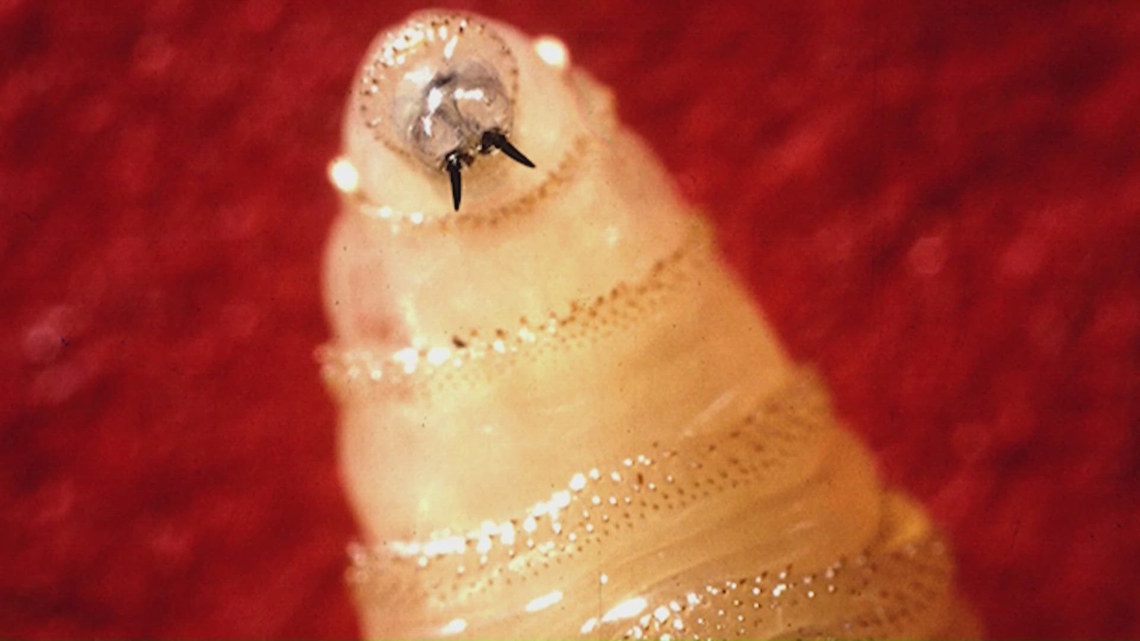
The New World screwworm is a parasitic fly larva that infests the tissue of warm-blooded animals, including cattle, deer, pets and humans. The larvae invade open wounds and feed on living flesh. The U.S. Department of Agriculture (USDA) confirmed the first U.S. case in Zavala County, Texas, on Wednesday.
The pest poses a threat to the state’s $15 billion cattle industry – but in Friday’s update, the governor and the head of the Texas Animal Health Commission (TAHC) stressed that while the New World screwworm could impact food production if not contained, it will not impact food safety.
“This is not a food safety issue; this is a food production issue,” said Dr. Lewis “Bud” Dinges, executive director of the TAHC. “New World screwworms do not infest meat, fruits, vegetables, or other food sources … Infestations from the pests can be prevented. Animal owners need to look at their animals as often as possible, stay vigilant, monitoring for wounds that can be covered or treated. This is not an infectious disease. And these flies have to either lay eggs in, on, or near the wound for the animal to become infested.”
Abbott also noted that there is a “long-established prevention and cure” for the New World screwworm.
“A cure and prevention that the federal government has implemented in the past. It involves the release of sterile flies. It breaks the pests reproduction cycle. The prevention requires the release of millions of sterile flies in targeted regions,” Abbott said. “The USDA is now importing and dispersing those flies into South Texas, and the USDA is also constructing a new sterile screw worm production facility in Edinburg. It is essential that that facility be up and running as quickly as possible.”
The state of Texas also established the Texas New World Screwworm Response Team last year, which brought together livestock producers, veterinarians, wildlife experts and federal partners to prepare ahead of the screwworm’s possible arrival in Texas.
On Friday, Abbott updated his previous statewide declaration to authorize the use of all available state government resources to respond to the New World screwworm’s presence and to reassign all resources from across the state to address the screwworm. He also said he is making available any and all state personnel, including university systems, to accelerate the movement of sterile flies through the state and to accelerate the construction of the sterile screwworm production facility in Edinburg.
At this time, Abbott said the state of Texas will prioritize resources in Zavala and Uvalde counties, but the prioritization list will be expanded as needed if an infestation is identified elsewhere.
What’s the latest with the confirmed case of New World screwworm?
Dinges said TAHC and USDA staff have been in close communication with the owner of the infested calf. The herd has been inspected for additional infestations, and none have been found. The herd has also been treated.
The calf that had the infested navel wound is doing well, Dinges said, and the navel wound is healing nicely.
Dinges noted that the owner and ranch foreman’s cooperation and their continued vigilance have been “excellent.”
What can Texans do to prevent the spread of New World screwworm?
Abbott listed the following steps Texans can take to prevent the spread of New World screwworm:
- Check animals daily. Check for any wounds, even small ones like tick bites or navels on newborns or other openings, and treat wounds promptly
- Work to reduce fly populations around your operations
- Report immediately. Any suspicion of New World screwworm in wounds should be reported to the TAHC, and anyone can report
- If there is an animal suspected of having the screwworm, do not move it. Instead, contact the TAHC or TPWD
You can report suspected cases to the TAHC’s 24-hour veterinarian call line at 1-800-550-8242. If you see deer, feral hogs, exotic game animals, or other wildlife showing signs of infestation or unusual wounds, report it to the TPWD or your local TPWD wildlife biologists. TPWD biologists can be reached at 512-389-4505.
“This is a highly treatable condition if acted on quickly, whether it be for someone’s pets or someone’s cattle. Constant contact with your veterinarian is very important to be able to relay any observation of any open wounds or any infestation so that it can be treated,” Abbott said. “And whether it be a pet, or cattle, or other type of livestock, the goal is to treat it as quickly as possible. Pets like dogs and cats with outdoor exposure and untreated wounds need close monitoring all the time.”
“Bottom line: Texas is resilient. Our producers, veterinarians, and state officials are among the very best in the United States. It is critical for them and for our fellow Texans to stay vigilant and informed,” Abbott added. “We have, in the past, prevented, as well as eradicated this pest, and we can do it again.”
For the latest updates and resources, visit the TAHC’s website at TAHC.texas.gov, the Texas Parks and Wildlife Department’s website at TPWD.texas.gov, and/or USDA at screwworm.gov.