
The trial of Anthony, accused of killing Austin Metcalf, is expected to last two weeks. He faces up to life in prison if convicted. He has pleaded not guilty.
MCKINNEY, Texas — The trial of 18-year-old Karmelo Anthony continues today in Collin County, after last year’s fatal stabbing of 17-year-old Austin Metcalf during a Frisco ISD track meet.
Jury selection began Monday, June 1 and continues today. The trial is expected to last about two weeks.
New to the case? Watch this overview.
WFAA will stream updates with analysis after the trial each day at 8 p.m. on our free streaming app WFAA+. Here’s how to download it for free.
Frisco track meet stabbing trial: Timeline of the case
The timeline of the case begins April 2, 2025. See a full timeline of the case here.
Anthony, a former student at Frisco Centennial High School, is charged with murder in the April 2, 2025, killing of Metcalf, a student-athlete at Frisco Memorial High School.
Background: Who is Austin Metcalf? Who is Karmelo Anthony?
Investigators say that morning, at a track meet at Kuykendall Stadium, a confrontation began under a team tent where athletes gathered during inclement weather. It ended when Metcalf was stabbed in the chest. Anthony was arrested and has claimed self-defense.
The case quickly drew intense national attention, fueled by social media debate centered on the races of the two young men, public protests, online threats and allegations of doxxing involving people connected to the proceedings.
Because Anthony was 17 at the time of the incident, Texas law allows him to be tried as an adult, and he faces a possible sentence ranging from five years to life in prison if convicted. Because the death did not meet the qualifications to be charged as a capital murder, and because of Anthony’s age, the death penalty was never an option in the case.
Trial rules
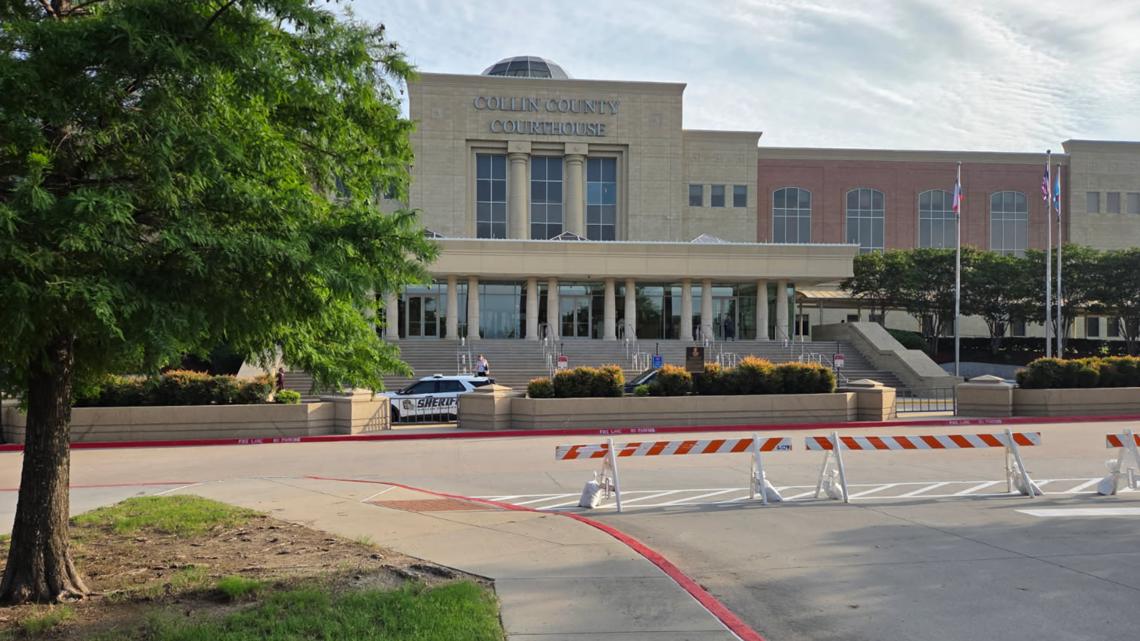
Security at the courthouse will be tight.
Judge John Roach Jr. has banned cameras, livestreams and audio recording inside the courtroom. He also designated a security perimeter around parts of the courthouse grounds barring the public — and potential demonstrators — from gathering in those areas. The judge has also issued a gag order limiting public comments about the case from attorneys, witnesses, investigators and others directly involved in the proceedings.
With public seating limited, developments in the case will come from live reporting from inside the courtroom. WFAA has a team covering the case. Collin County reporter Jobin Panicker will be inside the courtroom each day, alongside a courtroom sketch artist. Senior crime and justice reporter Rebecca Lopez will also be at the courthouse each day, both in and out of the courtroom, chronicling case developments. WFAA has also arranged for a legal expert to sit in on the proceedings each day to help provide context and analysis on the WFAA+ daily evening wrap-up.
Background: A visual tour of the actual courtroom.
Day Two: June 3, 2026 – jury selection continues
Here’s the latest from Jobin Panicker on Howard’s back-and-forth with the potential jurors.
Howard asked the panel: If the defense brings up self-defense during the trial, would they expect them to have to prove self-defense? The answer is no, he told them. Some prospective jurors said they are surprised at that, that the defense does not have to prove self-defense. Howard reminds them who has the burden of proof in the case — the prosecution.
Howard described how the judge decides whether the issue of self defense has been sufficiently raised, and how it would be included into the charge for the jury to decide.
Howard switches gears, probing for other biases in the jury pool by asking them to rate “the country’s immigration policies” on a scale of 1 to 10. It provokes a discussion, with some panelists asking for clarification and some saying they’d rather not answer.
Anthony at the defense table took notes as jurors spoke.
Next, it was defense attorney Mike Howard’s turn to question potential jurors. Jobin Panicker filed this update:
“I am proud to represent Karmelo Anthony,” Howard told the jury pool. “I’m going to refer to him as ‘Melo.’ His life is literally going to be in your hands.”
“Do you have a right to defend yourself?” Howard asked the panel.
He asked panelist after panelist about bias and prejudice: “How many of you feel like I can’t set that aside?”
One potential juror said he’s not sure he cannot set aside his prejudice after watching the news and his “detective brain” came on. “I’m just being honest,” he added.
Another said he is a critical thinker. “In my younger years I’ve been in similar situations,” he said. “I want a fair and unbiased trial for this young gentleman.” But he said he does not feel he can put his bias. “I don’t want another 600 people coming in here and Judge Roach coming after me,” he said. People in the courtroom laughed.
Several jurors said their personal experiences would influence their decision in this trial and not make them a good candidate for the jury.
A number of potential jurors in the pool say they cannot put bias and prejudice aside, cannot unsee or unhear what they’ve heard about this case, cannot give a life sentence, cannot send a young man to prison, and cannot overlook if the defendant chooses not to testify.
Some jurors said that, despite the defense not carrying a legal burden to put on any evidence whatsoever, they still feel like the defense needs to present a case to “prove something.” Defense attorney Howard reminds them who has the burden — the state prosecutors.
Defense lawyer Toby Shook is sitting next to Anthony while Howard is questioning the jurors.
A juror wants an example of reasonable doubt. Howard told him he cannot give one because each case and circumstance is different. He only said reasonable doubt is a heavier burden of proof than “preponderance of the evidence” and “clear and convincing,” which are separate legal standards. “Reasonable doubt” is the highest evidentiary burden in American criminal law.
“Why might a defendant not want to testify?” Howard asked the pool. Answers from jurors included that the defendant is not comfortable, that he was advised not to, that he is young or shy, and that he does not want to self-incriminate.
Howard then discussed the definition of deadly force in self-defense, as well as the “duty to retreat” doctrine.
A prosecutor objected to a line of questioning. Judge Roach held a brief side conference with attorneys, but it was brief.
Rebecca Lopez filed this report recapping the morning session, which she viewed along with Jobin Panicker from inside the overflow courtroom watching a video feed of the jury selection taking place in the nearby jury room.
Karmelo Anthony is wearing a blue suit with a pink shirt, and is sitting next to defense attorney Mike Howard.
Prosecutor Dewey Mitchell began his question-and-answer session with the jury pool by reminding them they are there to keep the trial fair.
“For some people this may not be the right case for you,” he said, adding that he is “looking for people that can listen, keep an open mind, listen to evidence and render a fair verdict.”
Mitchell said his greatest fear is not getting a chance to talk to a potential juror and get an idea if they can be fair.
He said jurors have to presume the defendant is innocent. “Does anyone feel like the person has already done it?” he asked the pool.
He said the burden is on the state to prove beyond a reasonable doubt that the defendant is guilty. The burden is not on the defendant and he doesn’t have to take the stand. Mitchell said that defendants have that right under the 5th Amendment to the U.S. Constitution.
He asked the jury pool if anyone would hold it against him Anthony if he did not take the stand. “I don’t know the answer to that,” one prospective juror said in response.
Some of the jurors said they noticed the small number of demonstrators that occasionally gather outside in the courthouse parking lot. That morning, about a dozen Anthony supporters, identified by their T shirts, were present in the back of the parking lot away from the courthouse, and about half that number of other demonstrators were gathered peacefully nearby.
Mitchell asked if the outside influences could impact the jury pool’s decision. “It may affect me,” one prospective juror said.
Mitchell also asked about age and whether that would impact how they decided the case. “I think ‘what if that happened to my son,'” the panelist said.
Another juror brought up race. “I don’t know if I feel right putting a brother in jail,” the panelist said
Mitchell then asked biases and personal beliefs.
“It would violate my religious views to punish someone,” a potential juror answered.
Then prosecutor defined the different levels of murder in Texas, including negligent homicide, manslaughter, murder and capital murder.
Mitchell said that one criterial of murder is “taking a life by threatening bodily injury and then causes the person’s death.”
“You can’t fall back on I really just wanted to hurt them or injure them but didn’t want them dead,” Mitchell said.
Then he tells the panel about sudden passion in Texas. Jurors cannot consider that in the guilt-innocence phase — only in punishment.
Then Mitchell revisited the age issue, asking the panelists if they would be able to render a true verdict because of age.
“I can decide guilt or innocence, but because of age that, may affect me in punishment,” a prospective juror said.
“I don’t feel like I can make a decision to sentence someone young to prison for life,” another said
“Seeing someone who looks like a kid — I can’t determine verdict,” yet another answered.
“He looks like a child,” another said. “I can’t send him to jail. He could learn from his mistake.”
“Hard to look at a kid and send him to prison for life,” yet another said.
Sixteen other jurors agreed with these sentiments that the defendant’s age made it difficult for them to assess a long prison sentence if convicted.
They talked more about race. Mitchell said, in 30 years of practice, “never have I had this conversation with a jury before.”
One juror was candid: “I’m scared if I don’t do the right thing, I might not be able to live with that the rest of my life.”
At the end, Mitchell told them they can consider “sudden passion” in punishment and said if they determine that, the range then goes from 5-99 years to 2-20 years.
The prosecutor ended with a plea to the hundreds of panelists: “I pray for you all. I pray you will be able to do this. And I thank you all.”
10:40 a.m.
Jobin Panicker chronicled the end of the prosecution’s Q&A with potential jurors.
Mitchell, the prosecutor, applauds one juror for something they said. Again, because of the poor audio, the audience cannot hear what it was.
Mitchell: “Guilt-Innocence is a snapshot,” i.e., what happened during one moment in time.
“Punishment,” he said, “is a photo album.”
Potential juror: “I manage people, I’m a mom. I look at the behavior and go from there.”
Mitchell talked about defenses like insanity and self-defense. He called them “a legal justification.”
Mitchell then previewed what could be a position the prosecution intends to take to push back on Anthony’s claims of self defense: “You don’t get to provoke someone and then use force.”
Mitchell told the pool that the sentencing range for murder is 5 to 99 years to life. Is there anybody who cannot consider life for a punishment?” he asks the panelists.
Several jurors said “he looks like a child,” referring to Karmelo Anthony, and that they cannot consider life as a punishment.
One said: “People are going to think I’m a monster but…I have a hard time just considering five [years].”
The number of jurors who cannot consider the largest range of punishment is starting to increase.
10: 30 a.m.
Jobin Panicker reports that Mitchell, the prosecutor continued to question potential jurors.
He went down a row of potential jurors and asked: “Will age [of the defendant] affect your ability to [render a true verdict]?”
A panelist answered: “I don’t think I can make a decision about somebody so young. One mistake, one argument, one conflict, you can’t say he’s a bad person.”
Several prospective jurors said “…this is not a good week.” Mitchell: “This may not be the trial for you.”
Karmelo Anthony is sitting next to his lawyer Mike Howard. There is a pad of paper, a pen, and a water bottle in front of him.
Attorneys and staff on both sides are writing notes after each and every answer from a prospective juror.
A panel member asks Mitchell “Can you define reasonable doubt?” Mitchell said he cannot, as it will be different for each person.
Mitchell then tackles the race question directly, asking person after person how they feel about this statement: “I don’t feel comfortable finding an African American male guilty of murder.” Because of the audio setup in the courtroom, it’s unclear how they answered that question.
Mitchell asked the panel how they felt about this statement: “Race will affect my ability to determine guilt or innocence.” Again, their answers if any were not audible.
Mitchell: “In my 30 years [in law] I’ve never had this conversation with a jury before. We have to be honest about it.”
At one point he said: “I know nobody wants to be on this case.” People in the overflow courtroom laugh.
Mitchell reminds the panel that no one is getting “in trouble” with their answers. He asks again if they can put race aside and use the law and evidence to render a verdict.
Jobin Panicker reports some of the back and forth as jurors answer questions from prosecutor Dewey Mitchell, the county’s chief felony prosecutor and lead jury picker, according to a commendation he received a few years ago.
Juror: “I have a son the exact same age of the defendant. I don’t know if that will affect me… What if that had happened to my kid?”
Mitchell asks for a show of hands. “Who has high schoolers?” It’s unclear who, if anyone, raised their hands since jurors are not shown on the courthouse video feed which is, again, only broadcast inside an overflow courtroom at the courthouse.
A juror said she is an educator in Frisco ISD. “This is close enough to home, I am not confident I could completely be fair.”
Mitchell, to the jury pool: “How many teachers do we have?” Again, we do not know how many raised their hands, but Anthony and Metcalf were both in high school when the incident occurred, and educators will likely be called as witnesses.
A jurors said: “I don’t know if I feel right putting a brother in jail.” This draws a reaction in the overflow courtroom. Two men in front of Panicker shook their heads.
One juror said they have moral and religious beliefs that prevent them from sentencing someone.
Another is recounting an experience with their own child and possible bullying at school. Mitchell interrupts and says, “I’ll come back to you because I want to talk about self-defense.”
Mitchell then went over the charges. he said Texas doesn’t classify murder by degrees like in other states. Texas has different names for different types of homicide: negligent homicide and manslaughter (which is assessed based on recklessness of one’s actions), murder (intentional or knowingly taking of a life) and capital murder (murder plus committing another felony like robbery).
Mitchell: “What if someone says, ‘I didn’t mean to kill somebody?’” He asked jurors if they think that still constitutes murder. “There is nothing in the law that says I have to plan out to kill someone,” Mitchell said. A panelist asks about premeditation. Mitchell said that may interest you during the punishment phase.
Mitchell told the pool that the lawyers are looking for people “who can render a true verdict based on the law and the evidence.” He said at some point he will talk about what “sudden passion” means legally.
9 a.m.
Jobin Panicker reports that, like on Monday, jury selection is taking place in the jury room, and the press and public are watching from another courtroom via video feed. The closed-circuit camera feed — which is not broadcast publicly — is on and the voir dire has resumed.
Karmelo Anthony is seated next to attorneys Mike Howard and Toby Shook. Prosecutors Bill Wirskye and Dewey Mitchell from the Collin County district attorney’s office are also seated on the other side.
Each side will get 1 hour 45 minutes to question members of the jury pool. Then they will break for lunch.
“We got a lot of people, and for some people this ain’t the right case for,” said Mitchell speaking to the approximately 250 remaining members of the jury pool which is not visible on the video feed. “There are going to be 12 people to decide this case… Those 12 people take a different oath… that I will render a true verdict based on the law and the evidence.”
Mitchell told the jury that it doesn’t matter if they are conservative or liberal — he wants the jury pool to speak up and give their views. “I need to hear from ya’ll.”
Jury selection is set to begin again this morning, continued from Monday. Judge John Roach Jr. has said he hopes to have 12 jurors and six alternates chosen today.